| 11/13/2025: An Electoral S.A.T. Math Question: "2025 Is To 2017 As 2026 Is To ____ ?" [RightDataUSA] | |||||||||||||||||||||||||||||||||||||||||||||||||||||||||||||||||||||||||||||||||||||||||||||||||||||||||||||||||||||||||||||||||||||||||||||||||||||||||||||||||||||||||||||||||||||||||||||||||||||||||||||||||||||||||||||||||||||||||||||||||||||||||||||||||||||||||||||||||||||||||||||||||||||||||||||||||||||||||||||||||||||||||||||||||||||||||||||||||||||||||||||||||||||||||||||||||||||||||||||||||||||||||||||||||||||||
The election results from November 4, 2025 bear a striking resemblance to those from November 7th of 2017. In the aftermath of the 2025 Democrat sweeps in Virginia, New Jersey, New York City -- and elsewhere -- most right-wing analysts are trying to appear calm as they whistle past the graveyard in their attempts to dismiss the disaster as "completely expected", "limited to 'blue' states", "unimportant" and, most of all, "meaningless as far as next year's midterms are concerned".
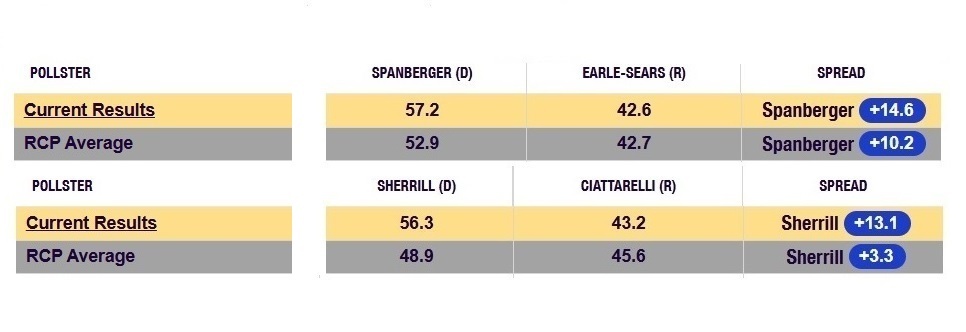
The polls sure were wrong -- but not the way we wanted them to be.
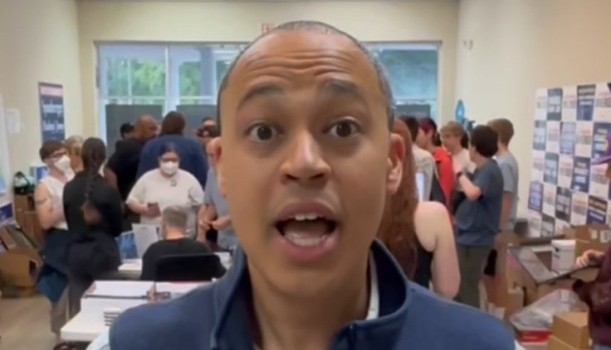
Possibly thinking: "Wow, the voters agreed with me! Republicans (and their children) DO deserve to die!"
Regarding the Republicans' gubernatorial defeats: it's one thing to be expected to lose, it's another thing to be completely obliterated and to have the calamity permeate the entire election ballot to the point where Republicans also hemorrhaged seats in the Virginia House of Delegates and the state Assembly in New Jersey.
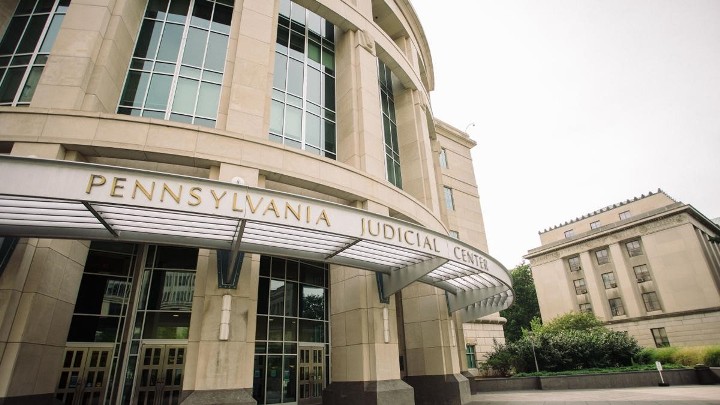
In 2025, Democrats cemented their control of the PA Supreme Court for years to come.
Pennsylvania voters had the opportunity to send those judges packing. Instead, all three judges who were up for retention were overwhelmingly returned (by nearly 25-point margins) to the court for another 10-year term. The PA Democrat Supreme Court thus maintains its 5-2 majority, and one of the two Republicans on the court barely qualifies as such; there is only one true Republican out of seven judges on the PA Court.
"Unimportant". . . "Not a big deal": Virginia, like some other solid "blue" states, is considering congressional re-redistricting. Virginia Democrats, soon to be in complete control of state government, would like to imitate California and disenfranchise Republicans via extreme gerrymandering. The results from last Tuesday surely embolden those Democrats. A small minority of New York City voters just elected a radical alien socialist as mayor. Tell the good people of California, Virginia and New York City that these results are "not a big deal". But the tiny, fragile twig that GOP pundits are seriously attempting to hang their hats on is this one: These results mean nothing for the future because "things change", "twelve months is an eternity in politics", blah blah blah. Platitudes, wishful thinking and other drivel are a poor substitute for actual analysis. On this website, we look at data rather than "feels". With the results from 2025 being so uncannily similar to the ones from 2017, it would be idiotic not to examine the results from 2018 and see how they might be pertinent to the upcoming 2026 midterms even if those midterms are "an eternity" away at this moment. The similarity of 2017 to 2025 is parallel to the relationship between 2016 and 2024. In 2016 Donald Trump won the presidency with 304 electoral votes and took 30 states. He won 45.9% of the popular vote. In 2024 Trump won the presidency again, this time with 312 electoral votes and 31 states (adding Nevada). He received 49.7% of the popular vote, the improvement coming not at the expense of his Democrat opponent but from the deterioration of third-party candidates, whose vote share was 4% less in 2024 than it had been in 2016. Kamala Harris actually took a greater percentage of the popular vote (48.2%) than Hillary Clinton had (48.0%). The parallel doesn't quite carry over to the House, where Republicans were in much better shape after 2016 than they are after 2024 (a net loss of 21 seats). But that's mainly because of what happened in 2018 -- which is the whole point here -- with the GOP losing many seats. Those losses were only partially offset in 2020 and 2022. After 2016 Republicans controlled the Senate by 52-48. After 2024 they now have a 53-47 advantage. That's pretty similar. Having compared 2024 to 2016, let's now shift one year and consider 2025 vs. 2017. Because 2021 was a significant factor in the false optimism which accompanied future elections in New Jersey and Virginia, we will show data for that year as well. 2017:
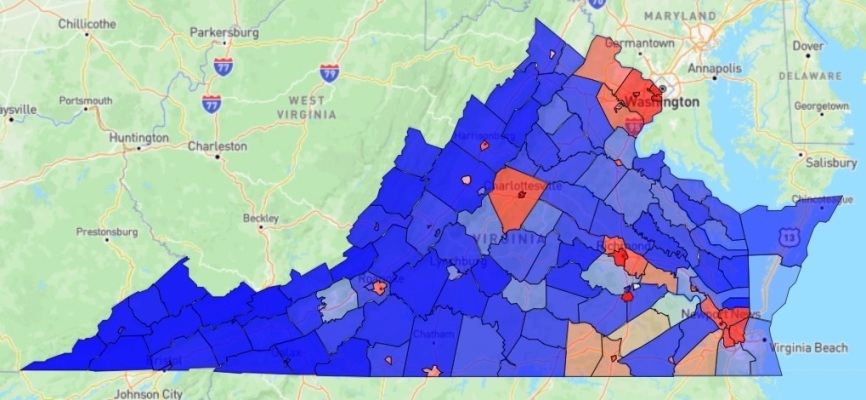
Happier days: 2021 gubernatorial election results in Virginia 2021:
Adding to the false hope in NJ was Trump losing by "only" 5.9% in 2024 and Curtis Bashaw losing by only 9.7% for the Senate. Also there was a voter registration shift to the right, a net change of 100K between 2022 and 2024, but the Rats were still up 900K (13.5%). In 2025 things improved, with the GOP being down 855K and 12.9%. Whoopee. As far as the 2025 elections in New Jersey were concerned, that wasn't false hope -- that was no hope. Turnout helped Republicans overcome some of their disadvantages in NJ in 2021 (registration deficit and state-level gerrymander) but things would return to normal in 2025 despite the indications from some occasionally cheery -- but sadly inaccurate -- pre-election polls. In Virginia there was an actual basis for hope after 2021 -- for a little while. There are no partisan voter registration stats to go by, however the election results were so encouraging that Republicans were expecting further gains in 2023 and 2024. In 2023 they failed to pick up the one state Senate seat they needed to get to 20-20 (GOP Lt. Governor would break the tie), and they lost 3 seats in the state House of Delegates, which was the exact number required to lose the House, giving Democrats full control of the state legislature and derailing any agenda GOP Governor Glenn Youngkin may have had. In 2024 Trump reduced his deficit from 10.1% to 5.7%, but his margin of defeat (260,000 votes) was still the second-worst of any GOP candidate in Virginia history, second only to Trump in 2020. Even in percentage terms it was the worst (aside from 2020) of any GOP nominee since Goldwater in '64. False hope extended to the 2024 senatorial campaign of Republican Hung Cao, whose 2022 showing as a House candidate in CD-10 was considered to be impressive. He lost by merely 6.5% that year in a district which was designed to give the Democrat a 10-12 point win. Whoopee again. Many delusionals thought that Cao could keep it close against Timmy Kaine in 2024, but few polls ever had him within single digits. Cao "overachieved" again. He only lost by 9 points. There was no false hope regarding GOP chances in Virginia in 2025; there was no hope at all aside from perhaps the Attorney General race. Polls showed a tossup but it turned out that a majority of Virginia voters agreed with the Democrat candidate on the pertinent topic of slaughtering Republicans and their children. 2025:
Republicans can be thankful for the lack of state Senate contests in NJ and VA in November, 2025; they couldn't lose more seats there if there weren't any elections. 2025 New Jersey gubernatorial results by region:
The above results for the 2025 Governor election are of course still unofficial (data as of 11/10) but are at least 95% complete in most counties. We defined the regions of New Jersey here: November 2025 Gubernatorial Elections -- New Jersey & Virginia. The Republican percentage of the vote collapsed to pre-2021 levels in all regions, even if not quite (in some areas) as bad as the GOP percentages from 2017 . Only in the Central Coast area did Jack Ciattarelli compare favorably at all to his results from 2021. In every other region of the state he finished well behind not only his surprisingly competitive 2021 performance but also behind Trump's mediocre showing in 2024. GOP results in the critical (and supposedly right-trending) northern part of New Jersey were especially disappointing. South Jersey was also a disaster for Ciattarelli. He had come barely one point away from winning that region in 2021 but lost it by a whopping 15 points last week. As we predicted, turnout in the ghetto areas of New Jersey returned to normal from the 2021 dropoff. That certainly wasn't good news for the Republican, but his problems were hardly confined to the worst areas of the state. Also, slightly-improving voter registration figures apparently aren't a guarantee of electoral success -- especially when those voters decline to participate. 
Artist's conception of the GOP's 2018 election results
Back to 2018:
An ongoing story throughout 2018 was the number of Republican incumbents in the House of Representatives who suddenly decided that they would not seek re-election in November. There were 23 Republicans who declined to run again for any office, and 11 other House Republicans who chose to run for a different office. Many of these 34, such as former House Speaker Paul Ryan, were anti-Trump moderates or liberals in marginal districts who were content with the prospect of potentially being replaced by Democrats. When trying to explain the debacle which resulted that November, with the GOP losing 40 House seats, the voluntary exodus was a convenient excuse albeit a false or at least incomplete one. Of the 34 Republicans who walked away in 2018, only 10 of them were replaced by Democrats. That's a considerable number, but a far cry from 40. The far bigger reason for the Republican party demise was the 30 incumbents who ran for re-election and lost. Seven of the total of 40 GOP losses occurred in California, which had just legalized a new form of Democrat electoral chicanery known as "ballot harvesting". That tactic allows ballots to be collected and counted for weeks after election day. Of the 7 Republican seats which evaporated in CA, at least 5 of them required "extra time" for the Democrat to eventually prevail. In 2018 the Real Clear Politics generic congressional polling final averages were GOP 44.9%, Democrat 53.3%. That polling could hardly have been more accurate -- after all the ballots were finally counted, the House vote share was GOP 44.8% (was 49.1% in 2016), Democrat 53.4% (was 48.0% in 2016). In case you're wondering about 2026 at this point, the current RCP congressional polling averages are GOP 42.0%, Democrats 46.1%. There are still lots of undecideds 12 months out from the election, but that 42.0% mark is abysmal. The whistlers past the graveyard now have another data point to ignore if they intend to remain adamant that 2026 can't possibly be as bad as 2018 was. 
Senate results from 2018
The House went up in flames but Election Night 2018 was a good one for Republicans in the Senate. Good, but not great. The 2017 GOP defeat in Alabama had left the Republicans with a narrow 51-49 majority. In 2018 they picked up 4 Senate seats (FL, IN, MO, ND) but also lost a pair of seats which they had previously held (AZ, NV) for a net +2. For a little while there also seemed a possibility of the GOP losing Thad Cochran's seat in Mississippi.
Here, at last, is how the playing field stands as we head into 2026: Before we look at the prospects for the House in 2026, let's quantify what happened in 2018. In 2018 there were 80 districts (out of 435) across the nation which we would classify as marginal -- being in the range of D+5 to R+5. Those 80 are worth examining because they were the districts most likely to change hands. During any kind of "wave" election, as we saw in 2018, obviously more of them will change hands. Districts which are outside the marginal range are normally considered safe unless there is a wave of unusual intensity or there are other circumstances which make an incumbent vulnerable despite the lean of his district. Some facts about those 80 marginal districts in 2018:
Additionally, Republicans lost 8 House seats which were not in the marginal range and were assumed to be at least moderately safe. Six of those 8 districts saw GOP incumbents bite the dust; only 2 were open seats (one more dagger in the feeble "we lawst just coz of all the re-tyre-mints!" argument). The above data illustrates the impact of the 2018 "blue" wave in the House. Even though the 80 marginal districts tilted slightly to the right on average, Republicans still managed to lose 61 of the 80. And on top of that the 8 others which were supposed to be safe-ish. That's what a massacre looks like, so you'll recognize it if you see one again in 2026. As noted, the "marginal playing field" was tilted towards the Republicans in 2018. If the parties had won every tossup district in which they were favored and then split the 10 even districts, Republicans won have won 53 out of those 80 districts instead of just 19 of 80, a difference of 34 seats. Give the GOP 34 more House seats in 2018 (they would've had control, 234-201) and suddenly the second half of Trump's first term looks a lot different. We have looked at all House districts for 2026, factoring in new maps in Texas, Missouri, Ohio, North Carolina and California and we are assuming they are not overturned in court prior to ever being used. Try to look surprised when the partisan Democrat gerrymander in California passes judicial muster but Republican maps elsewhere do not. A new Democrat gerrymander was just approved on November 11 by a liberal judge in heavily-Republican Utah, which creates two more marginal districts (not being counted here yet) and very well could cause two Republicans to lose in 2026. In Utah. Pending upcoming Democrat gerrymanders which are still on the drawing board in states like Virginia, Maryland, Illinois and Colorado, and pending the much-anticipated Supreme Court ruling which may remove the requirement for certain states to create anti-White districts, here is how the House battleground is taking shape for 2026: There are currently 91 House districts which fall into the D+5 to R+5 range according to our ratings. We count 41 of those districts as having GOP incumbents and 41 with Democrat incumbents. The remaining 9 districts have no incumbent running, and that number will increase over the next few months. Including currently open seats, Republicans must defend 45 districts and Democrats 46. That's about as even a breakdown as can be.
The likely effects of the ongoing redistricting currently are:
We will cover the Senate prospects for 2026 in a commentary which will shortly follow this one. Conclusion: With even more re-redistricting to come, forecasting the outcome of the 2026 U.S. House elections from this far out is just a guessing game. Democrat-controlled states including (but not limited to) Virginia, Maryland, Illinois, Colorado and New York are lining up to disenfranchise Republicans further whether the law permits them to do so at this time or not. Maryland has only one GOP congressman left to be exterminated, but those other states can do much more damage. As we've mentioned, even rock-solid Republican Utah is being forced by a liberal black-robed tyrant to hand over 1 or perhaps even 2 House seats to Democrats (Utah only has 4 altogether). Some Republican states, perhaps including Florida, Kansas, Nebraska and Indiana can do unto Democrats as Democrats in other states will be doing unto Republicans. But deep-"red" Indiana has already chickened out, Kansas (like Indiana and Missouri) could gain only 1 seat at most -- they all count, so don't scoff too much -- and the GOP can't gain any in Nebraska but can save one which otherwise is about to go down the toilet. Only in Florida is there the potential for a Republican state to get some "California-style" revenge on Democrats, but they could overextend themselves and wind up worse off than where they started (as could easily occur in North Carolina). The Supreme Court may come to the rescue. Do not hold your breath waiting for that. A case is pending, brought by a group of White voters in Louisiana who are challenging the racist congressional district map which was demanded by a judge and then used for the 2024 House elections. These disenfranchised voters are suing in an attempt to strike down a map which created a second black-majority district in their state. If the USSC rules in favor of the plaintiffs, professional racists are concerned that all racist Democrat gerrymandering everywhere -- which has been "the law" since at least the early 1990s -- will collapse, thereby eliminating several districts ("19" is the magic number they keep quoting) which are currently held by black Democrats, and those Democrats will all be replaced by White Republicans. As a result, the GOP would firm up its control of the House such that no amount of Democrat gerrymanders in California, Virginia, New York, Illinois or wherever can offset. This is utter nonsense. First the case has to actually be decided and the Supreme Court is in no hurry, especially in an election year; it will surely be 2026 before anything happens. Secondly, the court has to decide the right way. Does anyone really expect there to be 5 votes for doing the right thing here? John Roberts can almost certainly be relied upon to do the wrong thing. Again. Then there has to be sufficient time to draw new maps in the affected states. And sufficient time for the immediate Democrat lawsuits to be heard. And then those suits must be rejected so the new maps can be implemented. Good luck with all that. And then things have to work out the way panicky Democrats fear they will. Let's take a look at how the Democrat crystal ball came up with this cockamamie number of "19" seats which they claim are in jeopardy if the USSC disallows racist (i.e. Democrat) gerrymandering in certain southern states. Remember: this stuff was never about race; it was always about partisan politics. Whenever you see the word "black" or "minority" in some racist court ruling, replace that word with "Democrat" if you want to know the truth. As best we can guess from trying to interpret the feverish nightmares of Democrats, here are the Magic 19:
So there you have it: 19 House seats which are currently held by black Democrats. If the recently created maps in MO and NC hold up in court, then the GOP will be +2. If the Supreme Court does the right thing and does it promptly, there is a good chance for Republicans to reclaim the two seats (AL-2, LA-6) which black-robed leftist dictators stole from them in 2024. There will be no further developments in Missouri or North Carolina. That leaves Florida and Georgia as the only hopes for inflicting some damage on the Rats. That's much easier said than done. No matter what lies Democrats are telling about this upcoming court ruling, Republicans will never get anywhere near +19. Doing so would require them to eliminate most or all of the above districts and then create ones which will elect a Republican. And then have those district maps persist despite Democrat lawsuits. That's completely impossible, and Democrats know it. But they never fail to play the race card or the victim card whenever they can, the media swallows that shit up and then regurgitates it for the purpose of bamboozling low-info, low-intelligence voters into voting (D). The fluctuating re-redistricting landscape is making 2026 a unique year for which to forecast House elections, and that will be true until all maps are final. Even ignoring that factor for the moment, there is already substantial evidence to conclude that the 2026 results will mirror the results from 2018; conversely, at this time there is zero evidence (wishful thinking is not "evidence") that the 2026 results will not mimic 2018, at least as far as the general direction those results will take. To what degree that will happen is something that can't be anticipated with any precision yet. It's very possible that Congress in 2027-28 will look very much like the one from 2019-20, with Democrats -- no matter how slender their majority -- marching in lockstep in full control of the House ("Peach Mints are back on the menu immediately!") while disunited Republicans perhaps cling to nominal Senate control with a lame duck in the White House. Tags:
2025
2026 (uh oh)
Virginia
New Jersey
And just about everywhere else
| |||||||||||||||||||||||||||||||||||||||||||||||||||||||||||||||||||||||||||||||||||||||||||||||||||||||||||||||||||||||||||||||||||||||||||||||||||||||||||||||||||||||||||||||||||||||||||||||||||||||||||||||||||||||||||||||||||||||||||||||||||||||||||||||||||||||||||||||||||||||||||||||||||||||||||||||||||||||||||||||||||||||||||||||||||||||||||||||||||||||||||||||||||||||||||||||||||||||||||||||||||||||||||||||||||||||
| 10/24/2025: November 2025 Gubernatorial Elections -- New Jersey & Virginia [RightDataUSA] | |||||||||||||||||||||||||||||||||||||||||||||||||||||||||||||||||||||||||||||||||||||||||||||||||||||||||||||||||||||||||||||||||||||||||||||||||||||||||||||||||||||||||||||||||||||||||||||||||||||||||||||||||||||||||||||||||||||||||||||||||||||||||||||||||||||||||||||||||||||||||||||||||||||||||||||||||||||||||||||||||||||||||||||||||||||||||||||||||||||||||||||||||||||||||||||||||||||||||||||||||||||||||||||||||||||||
Although the elections may be tantalizingly close (in truth, they probably won't be that close), the likeliest outcome for the Republicans is. . .

The races have generally (but not consistently) been tightening in both states, especially according to polling organizations which are classified as Republican-leaning by liberal media sources. Some hardcore leftists (e.g. Washington Post) are cheerleading for a Democrat blowout in Virginia, but the ones who attempt to be less transparently liberal forecast the contests as being moderately competitive. Close though the races may be, as things stand now both Jack Ciattarelli (NJ) and Winsome Earle-Sears (VA) appear to be heading for losses. It's up to the good voters of New Jersey and Virginia to get out and vote and prove the pollsters wrong.
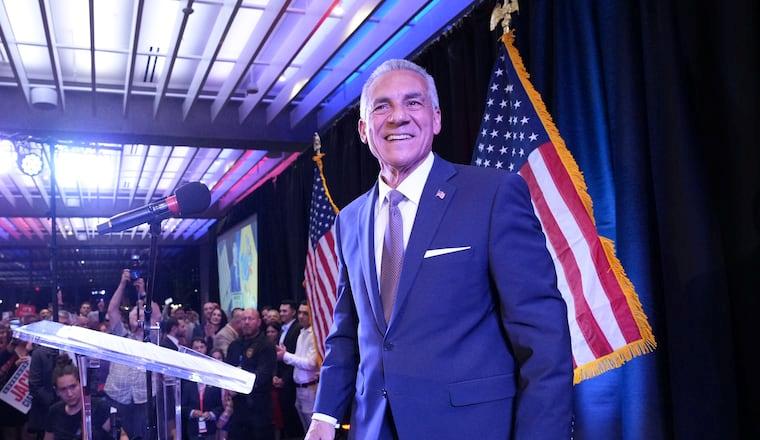
Photo credit: inquirer.com
Background:

Photo credit: app.com
The 2021 election was mainly a referendum on Murphy's first term, with Ciatterelli being regarded as sufficiently bland and moderate to avoid alienating potential crossover Democrat voters which any Jersey Republican requires in order to have a chance of winning a statewide election. Murphy is a huge supporter of the illegal importation of new Democrat voters from foreign countries, and he designated New Jersey as a sanctuary state. He also took several steps to hinder the deportation of illegals, such as not permitting law enforcement to ask about immigration status. By 2021 many New Jersey voters had grown weary of the invasion and their disaffection hurt Murphy's re-election chances. Nor were the voters pleased with the numerous tax increases which were passed by the overwhelmingly Democrat NJ legislature.
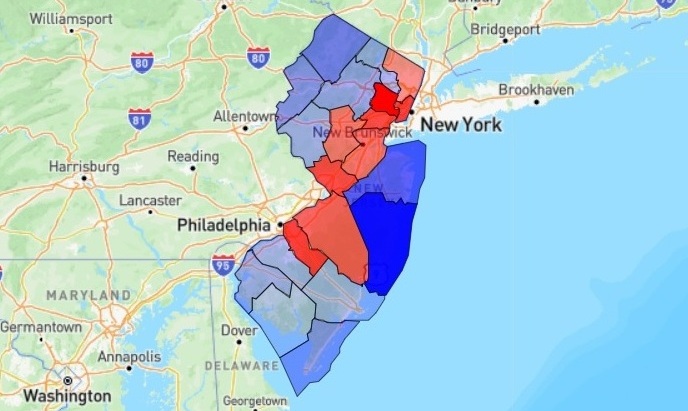
2024 presidential election results in New Jersey
Geography:
West Jersey and the Central Coast are the most Republican areas of the state; together they normally cast 28-30% of the statewide vote. Unsurprisingly, Ghetto Jersey is by far the most Democrat area of the state; it delivers about 18% of the statewide vote and gives a tremendous margin to whatever Rat is running. Of the three recent elections (2017 Governor, 2021 Governor, 2024 President) which we will be focusing on for the purpose of establishing trends, Trump did the best of any GOP candidate in this region, but still received only 32% of the vote. Central Jersey (epitomized by places such as Trenton, New Brunswick and Princeton) is consistent in its anti-Republicanism and provides approximately a 16-point margin for the Democrat while accounting for 16-17% of the statewide vote. South Jersey is the largest region both in land area and in number of votes. It accounts for about 22% of New Jersey's votes and can be marginal. It was heavily against Ciatarelli in 2017 but he nearly won there in 2021 before the region swung back a few points to the left against Trump in 2024. The Urbanized North is the most marginal region now and is the one which is moving most noticeably to the right although still slightly favoring the left. It is this area which GOP analysts see as the key if they are to win in New Jersey. Republicans have recently been competitive in the 9th congressional district which lies almost entirely in this region, despite being grossly outspent and despite a Democrat gerrymander which deliberately omits the better parts of Passaic County. Ciattarelli improved here by 12 points (net) between 2017 and 2021 and Donald Trump nearly won this region, losing by only 1.5% in 2024.
The next table shows the margin of victory (or defeat, if the number is negative) by region for the GOP candidate in these three elections:
Finally, the number of votes cast by region, along with the region's percentage of the statewide vote:
One of the keys to the near-upset in the 2021 gubernatorial election was the fact that many ghetto voters (Democrats, obviously) chose to sit that one out rather than vote for Murphy. The share of the statewide vote from Essex, Hudson and Union counties dropped nearly 2 percent. Those voters were re-energized in 2024 to vote against Trump and the statewide vote share from the 3 ghetto counties rebounded to where it had been in 2017. Anti-Murphy apathy will not be on the ballot in a couple of weeks, but anti-Trump motivation will be -- here and everywhere else where an election is taking place (at least in "blue" areas). As was the case in the disastrous election years of 2017-18, Trump is always "on the ballot" as far as the left is concerned. Turnout in these off-year races isn't quite as meager as it is for little-publicized special elections which often take place at odd times (i.e. not November), but turnout still does not approach presidential-year levels. That means motivation, organization and money are the key factors to generating turnout; Democrats are normally substantially ahead in all 3 of those factors, and it shows. Voter Registration: 
Photo credit: redlineheadlines.com
Scott Presler and his organization have worked diligently over the past couple of years to increase Republican voter registration counts in certain states. Presler focused on Pennsylvania during 2024 and has been given inordinate credit for the GOP victories which occurred there -- Trump's win along with that of Senator Dave McCormick, and the important pickup of two House seats (CD-7 and CD-8) in Eastern PA.
2025:
The last time Republicans achieved a 40.9% or greater share of voter registrations in a November election in PA was 2003. This November, Pennsylvania voters will have the chance to oust 3 Democrat members of the state Supreme Court. Those members, along with their liberal colleagues, are responsible for the hyper-partisan gerrymander which has affected not only congressional districts in Pennsylvania but state legislative districts as well. These gerrymanders cost Republicans 4 U.S. House seats (and almost 2 others) from 2019-2024 and cost 12 state House seats -- exactly enough to give Democrats control. Republicans have a chance to eliminate some of the justices who caused those events to happen, and perhaps gain a majority on the PA Supreme Court in the process. 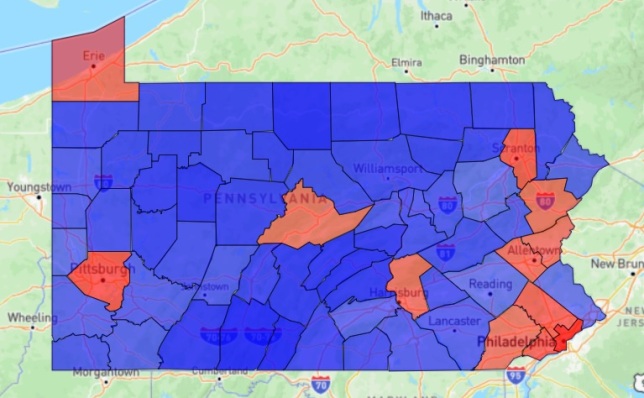
2024 PA voter registration, by county
After 2024, Presler and his vote registrars moved east to New Jersey in an attempt to turn that state "red". As in PA, trends in New Jersey were already favoring Republicans, although these trends have not manifested themselves in any victories. Trump's loss by 5.9% here in 2024 was actually the best showing for a Republican candidate since George Bush lost by only 2.4% in the 3-way election of 1992. Prior to 1992, the GOP won 6 presidential elections in a row in New Jersey before the state's demographics began to head rapidly south.
November 2024:
October 2025:
It is worth noting that a sizable number of New Jersey voters are neither Republicans nor Democrats. If the polls are correct, independents are favoring the Democrat by a substantial amount in the 2025 gubernatorial race. Going back to 2008, Republicans have added 614,894 voters in New Jersey and Democrats have added 742,790. However the recent data is more affirmative with the GOP registering large gains during 2024 and then almost as many again in 2025. Democrat registration has been stagnant during the past two years. Will the "Presler bump" in 2025 be enough to put Ciattarelli over the top on November 4? Current polling suggests it will not. He may be fortunate to lose by only as much as he did in 2021. Conclusion: It is being reported, even by far-left sources, that all is not well in Camp Sherrill despite her clear lead in nearly every poll. There has also been fear that black voters and other minorities will turn out at less than their usual rate, as occurred in 2021 (spoiler alert: that isn't going to happen again in 2025). The Naval Academy cheating scandal in which both Sherrill and her husband are allegedly involved isn't resonating at all with voters and (shockingly!) isn't being covered in the so-called mainstream media. Even lefties concede that Sherrill does not generate much enthusiasm, but the fact that New Jersey has nearly 1 million more Democrats than Republicans makes "enthusiasm" a rather moot point in the face of that landslide registration advantage. Furthermore, while comparatively few Democrat and independent voters may be excited about voting for Mikie Sherrill, they are probably quite motivated to vote against Donald Trump clone Jack Ciattarelli. Of course Ciattarelli is no such thing, but hatred is a powerful motivator for Democrats and no facts are going to be allowed to impede that hatred. Final prediction: Sherrill prevails by 2 to 4 points, with a decent potential for an even greater margin (say, 4-6 points). We'd positively adore being wrong about this outcome, but even if she only wins by 1 then we're still not quite wrong enough. Virginia: 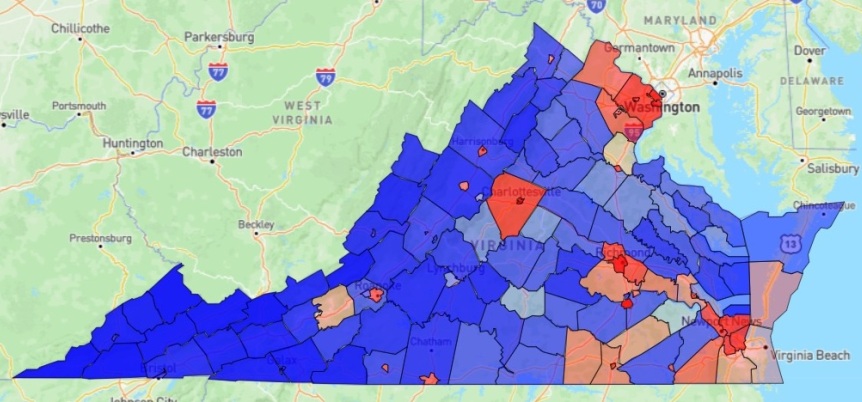
2024 presidential election result in Virginia
Background:
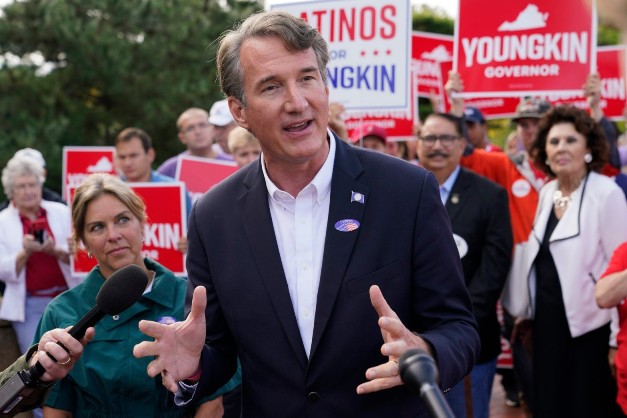
Photo credit: washingtonmonthly.com
The candidates: 
Photo credit: lifenews.com
GOP nominee Winsome Earle-Sears is an immigrant from Jamaica who arrived in the U.S. at the age of 6. She served in the United States Marine Corps for 4 years in the 1980's and became an American citizen during that time. Her political career commenced in the early 2000's when she won a race for the state House, upsetting a black Democrat who had been in office for two decades. She was the first Republican to win a state House seat in a majority-black district in Virginia since 1865. She later became the state's first female Lieutenant Governor (elected in 2021) and is the first black female to be elected to any statewide office in Virginia.

Photo credit: twitchy.com
Spanberger, a native of New Jersey, went from being a substitute schoolteacher and a postal inspector to (as of 2006) being a spy for the Central Intelligence Agency; a rather interesting career change, to say the least. When she first entered politics, Spanberger's CIA resume was sanitized so that it could be declassified and, according to ABC News, the former spook stuck "to carefully scripted lines, approved by the agency, when talking about her work" on the campaign trail.

Photo credit: NRCC
Republicans picked up 13 House seats in 2020 but Spanberger's wasn't one of them although a serious effort was made. Her district, which had been rated as R+10 prior to the 2016 Democrat gerrymander, was still slightly "red" and Republicans had it high on their list of potential pickups. Spanberger, then as now, occasionally talks like a moderate and did cast a highly publicized (and highly choreographed) vote against Nancy Pelosi for Speaker in January, 2019. Spanberger then spent the remainder of her first term in Congress establishing her liberal bona fides, but was able to conceal that fact from the voters as she reverted back to her faux-moderate persona.
Taking some of these regions together, Virginia can be divided into three pieces of approximately equal electoral weight. Two of the three nearly always favor Democrats. NOVA is of course the most Democrat-infested area, teeming with people whose livelihoods depend on the federal The portion of the state which is included in the Piedmont / Southside / Shenandoah / SW Virginia regions accounts for just under 30% of the statewide vote and gives Republicans their biggest margins of any region. The statistically insignificant (barely 2% of the vote), lightly populated Chesapeake Bay counties also support Republicans lately, by almost exactly the same percentages as obtained in the Piedmont / Southside areas. The Greater Richmond and Hampton Roads regions together outnumber NOVA in total voters, though not by a lot. They solidly favor Democrats in most races, and if a Republican is going to win a statewide election he needs to come close to getting 50% here. Youngkin did that in 2021 (he received about 48%) but Ed Gillespie didn't in 2017 nor did Donald Trump or Hung Cao in 2024. The latter 3 GOP candidates mustered only about 42% or 43% there; Youngkin won statewide, the others did not. Conclusion: Unlike in North Carolina in 2024, where the unpopularity of one GOP candidate (Mark Robinson) dragged down the entire statewide Republican ticket although some Republicans won anyway, the presence of violent, feral racist Jay Jones as Democrat nominee for Attorney General has had no impact on other Virginia Democrats in 2025; in fact, Jones still retains about a 50-50 chance of winning himself according to left-wing pollsters. So any Jones Effect on the gubernatorial race which would assist Sears can likely be discounted as non-existent. As of October 15, campaign finance reports showed that CIAbby had raked in $53.8 million and disbursed $48.4 million. The Sears campaign lags far behind, running on about half of what the Democrat has done in both of those categories. There is also a wide disparity between the two candidates in terms of remaining cash-on-hand, with about a 3:1 advantage to Spanberger as we head into the final days of the campaign. The Lieutenant Governor race and the one for Attorney General will end up closer than the Sears-Spanberger duel, but Republicans are likely to lose at least one of those two downballot tilts, and quite possibly both. There is some chance that they could win both (while still losing for Governor), but that is less likely barring a significant change in fortunes between now and November 4. The Virginia state Senate has been in Rat hands since they picked up the two seats they needed in 2019. It's been status quo since then, with the Republicans needing one seat to forge a tie and two to take control. With the L.G. probably going Democrat in 2025, one seat isn't going to be enough. The state Senate map for this decade has been gerrymandered to favor Democrats, and under those conditions the GOP is doing well to merely be down 21-19. A similarly gerrymandered state House map also strongly favors Democrats; again, the GOP has done well to even keep it close. The forecast for this November is not sunny for Virginia Republicans at the state legislative level, and they are going to need to overachieve a little more if there is any hope of thwarting the agenda of "Governor Spanberger". Ugh. Tags:
2025
Governor
New Jersey
Virginia
| |||||||||||||||||||||||||||||||||||||||||||||||||||||||||||||||||||||||||||||||||||||||||||||||||||||||||||||||||||||||||||||||||||||||||||||||||||||||||||||||||||||||||||||||||||||||||||||||||||||||||||||||||||||||||||||||||||||||||||||||||||||||||||||||||||||||||||||||||||||||||||||||||||||||||||||||||||||||||||||||||||||||||||||||||||||||||||||||||||||||||||||||||||||||||||||||||||||||||||||||||||||||||||||||||||||||
| 11/8/2023: Election 2023 -- It Wasn't ALL Bad News [RightDataUSA] | |||||||||||||||||||||||||||||||||||||||||||||||||||||||||||||||||||||||||||||||||||||||||||||||||||||||||||||||||||||||||||||||||||||||||||||||||||||||||||||||||||||||||||||||||||||||||||||||||||||||||||||||||||||||||||||||||||||||||||||||||||||||||||||||||||||||||||||||||||||||||||||||||||||||||||||||||||||||||||||||||||||||||||||||||||||||||||||||||||||||||||||||||||||||||||||||||||||||||||||||||||||||||||||||||||||||
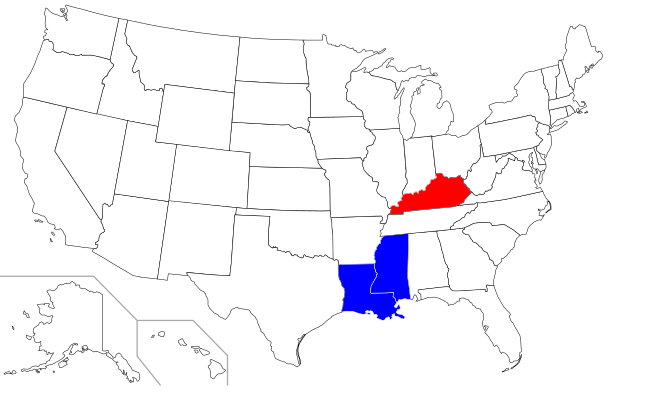
Yesterday's outcomes were almost entirely predictable yet were considered disappointing by the good people of America -- the same phenomenon as occurred in 2022 when the mis-named "Red Wave" never materialized and even positive developments were considered to be crushing defeats because those positive outcomes did not occur on the massive scale which many people ridiculously expected. Now on the positive side, Mississippi Governor Tate Reeves (R squish) defeated a faux-moderate Democrat who claimed to be kin to the beloved peanut-butter-and-banana sandwich eater, Elvis Presley. Apparently that's worth some votes in Mississippi. Republicans also increased their already-substantial majorities in the state House and Senate and swept all statewide offices. In Suffolk County, New York (Long Island) the GOP cruised to a "landslide" 56% victory in the race for County Executive, which means that Republicans now hold 100% of the important offices on Long Island including the area's four seats in Congress (for one more year). GOP gains in 2021 on Long Island foreshadowed congressional success here in 2022; this win in 2023, unfortunately, will very likely not mean anything as far as GOP chances of success on Long Island in 2024. Another race which was perhaps not of national import, but was something we touched on previously: A significant upset occurred in a local race in Allegheny County, PA (Pittsburgh) where long-term incumbent Democrat Stephen Zappala -- now running as a Republican -- defeated ultra-liberal Soros stooge Matt Dugan for District Attorney. Pending any post-election shenanigans by Democrat vote-counters, anyway. Results in Pennsylvania very often change significantly after election night as more mail-in ballots are This happy result in the D.A. contest took place even as Democrats were sweeping the rest of the county offices, as always, though the race for County Executive was closer than usual. A moonbat Democrat won by barely 2% in a county where Democrats outnumber Republicans 2:1. The Rats, who have re-elected Mr. Zappala every 4 years since he first took office in the late 1990s, have suddenly discovered some issues with him, now that he is a Republican albeit in name only. They tried the always-popular Race Card, accusing Zappala of desiring to bypass the black (Democrat, obviously) mayor of Pittsburgh and take control of the police department; they also falsely accused him of going easier on White criminals than black ones. The Dugan campaign, which needless to say outspent Zappala exponentially, also dredged up a tangentially abortion-related case from over 15 years ago in which Zappala's office charged a woman who'd had a miscarriage with a crime because she then kept the fetus in a freezer. The resurrection of this story was meant to, and did, trigger the pro-abortionists who don't wish to suffer any consequences regarding their own dead fetuses. Despite the massive Soros-funding advantage for the Democrat woketard, Zappala appears to have prevailed yesterday 51.6% to 48.4% with an estimated 30% of Zappala's support coming from Democrats. When we referenced this election and the possibility of a miracle upset previously, the hypothesis was that perhaps blue-collar moderate Democrats would cross over to assist Zappala. In light of recent events in Gaza and the unwavering Hamas terrorist support from the national Democrat party -- including their local racist Congresswoman -- we surmised that Allegheny County Jews, particularly in the Squirrel Hill area of Pittsburgh, might be sufficiently appalled to do something other than vote straight-ticket D for a change, even though yesterday's elections had nothing to do with Israel. So what did those voters do? Squirrel Hill is contained within the Fourteenth Ward of the city of Pittsburgh. For some context, in 2020 that area voted soundly against President Trump by a margin of 70% -- it was 84% for Biden, 14% for Trump. In 2016, that region's love for Hillary and hatred of Trump was expressed in nearly identical proportions (83% Hillary, 14% Trump). Yesterday the vast majority of Squirrel Hill voters again showed themselves to be atheistic, secular, ultra-liberal and self-loathing -- they are not concerned one whit about Israel as long as Netanyahu is in charge -- by demonstrating their allegiance to the Democrat party. But not by quite the normal amount. There was approximately an 11-point swing to the right in the Fourteenth Ward, with Dugan getting 74% of the vote to Zappala's 26%. Eleven points may not sound like a lot, but in this area it is significant. In terms of raw votes, Zappala got at least 1,500 more votes in the Fourteenth Ward than he would have if the usual percentages had applied. That number by itself did not alter the outcome of this election, however it was a welcome (though almost certainly temporary) development. Tags:
2023
Kentucky
Missisippi
New Jersey
Virginia
Abortionist
Ohio
Daniel Cameron
Pittsburgh
| |||||||||||||||||||||||||||||||||||||||||||||||||||||||||||||||||||||||||||||||||||||||||||||||||||||||||||||||||||||||||||||||||||||||||||||||||||||||||||||||||||||||||||||||||||||||||||||||||||||||||||||||||||||||||||||||||||||||||||||||||||||||||||||||||||||||||||||||||||||||||||||||||||||||||||||||||||||||||||||||||||||||||||||||||||||||||||||||||||||||||||||||||||||||||||||||||||||||||||||||||||||||||||||||||||||||