On October 27, one week before the state of California was inevitably going to approve its most recent Democrat gerrymander (it passed by 3,000,000 votes and will cost Republicans 4 or 5 House seats), Indiana Governor Mike Braun called for a special session of his state's legislature in order to retaliate against California to some degree. There's only so much that a relatively small state such as Indiana can do against a behemoth like California, but Braun and Indiana conservatives -- encouraged by President Donald Trump -- prepared to revise the Hoosier State's congressional district map in such a way as to enable Republicans to go from a 7-2 advantage in the Indiana delegation to possibly as much as a 9-0 sweep in a good election year.
Republicans have a solid hold on both houses of the Indiana state legislature, 70-30 in the House and 40-10 in the Senate.
The special session of the legislature did not even commence until December 1, however on November 18 a Twitter user named "johnny maga" posted a new district map which was allegedly proposed by the Indiana House Republicans. The map was accompanied by a statement from House Speaker Todd Huston in which he vowed that Indiana would stand up against the Democrat gerrymanders in California (which by then was a done deal) and Virginia. The Virginia plan is still on the drawing board but, if implemented, could cost Republicans up to 4 more seats in the U.S. House of Representatives.
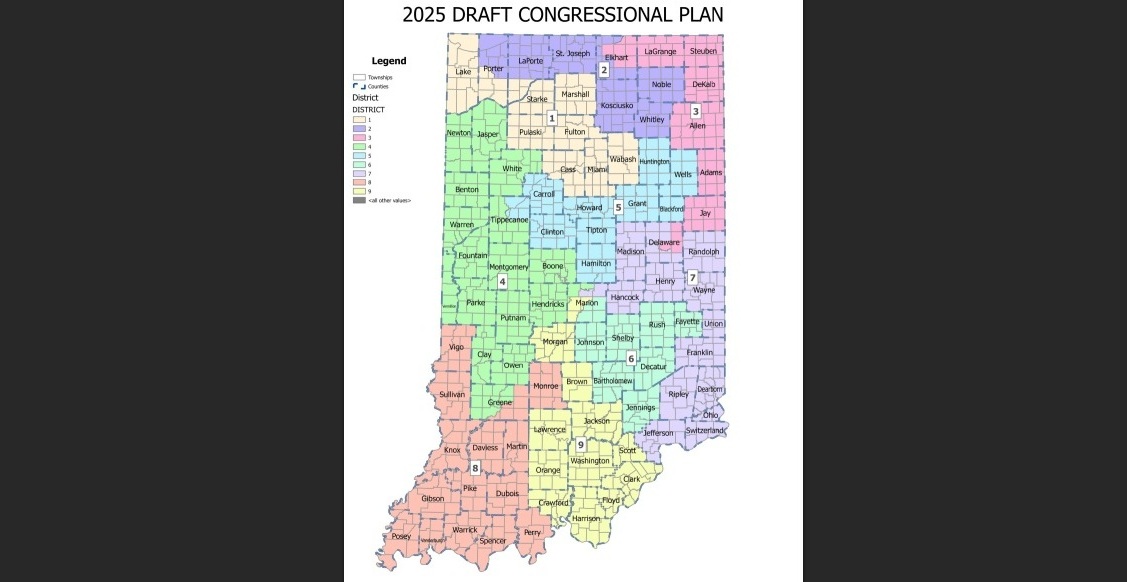
The proposed Indiana map from November 18 was ludicrous (not that such a thing has ever stopped Democrat map creators) and probably was never seriously considered; it contained two districts which stretched from Lake Michigan to practically the Kentucky border. On December 1 the Indiana House Republicans released a different map -- an eminently reasonable map with compact districts which is pictured above. It would obliterate one of the two Democrat-held House districts (CD-7) and would make the other Rat-held district (CD-1) into one which leans slightly towards the right.
Four days later the Indiana state House approved this new map by a vote of 57-41. On December 11, twenty-one RINOs in the Indiana state Senate became darlings (temporarily) of the liberal media by voting alongside every Democrat in order to sabotage their own party and defeat the new redistricting plan. The final vote was 19 in favor and 31 against.
Background:
Republicans already hold 7 of Indiana's 9 U.S. House seats, and have been in control by that exact margin since the 2012 election. The two districts which they perennially do not hold are CD-1 in the northwestern part of the state, and CD-7 which is most of the city of Indianapolis. The purpose of the new map was to alter these two districts sufficiently to favor Republican candidates in 2026, and to do so without endangering Republican incumbents in the other 7 districts. That is what California Democrats accomplished with their new gerrymander which eliminates 4 or 5 House Republicans while simultaneously protecting half a dozen Democrats who could be vulnerable to a minor "red" wave.
Indiana Congressional District 1 (CD-1):
 Indiana Congressional District 1
CD-1 has been in Democrat hands for almost 100 years without interruption; no Republican has ever won a House race there since the district was created in 1932. At that time Lake County (Gary, Hammond) was given its own congressional district, the rapidly growing county having gone from 38,000 residents in 1900 to a population of 261,000 by 1930. Since then, CD-1 has always contained most or all of Lake County, but in recent years Porter County and parts of LaPorte County have been added. Lake County has been losing population since the late 1960's, when Whites began fleeing in droves -- leaving behind a county and congressional district which thus became even more Democrat-oriented.
From 1974 through 2018 no GOP House candidate even broke 40% in CD-1 except for a fluke in 1994 and the time the seat was open in 1982. In 1982 racist Democrat Richard Hatcher was in charge of selecting his party's nominee after the incumbent in CD-1 died following the primary election. Hatcher bypassed better-qualified White candidates and forced his party to accept a black nominee. The Republican still lost by 13% in both 1982 and 1994, and that was as close as the GOP came during that 44-year interval.
CD-1 has become much more competitive recently, and the GOP realizes that even a fairly small shift to the right could result in an unprecedented House win there; the new map for 2026 was going to implement that small shift to the right.
In 2020, frequent (and hopeless) Republican candidate Mark Leyva received slightly over 40% of the House vote against Democrat Frank Mrvan. Donald Trump did even better than Leyva in CD-1 that year, taking a shade under 45%. That may not sound impressive, but it represented a vast improvement in GOP fortunes in northwestern Indiana.
In 2022 Republicans took a serious shot at unseating Mrvan by nominating (and funding) Jennifer-Ruth Green, an Air Force veteran and commercial pilot. Green claimed to be a conservative but foolishly distanced herself from Donald Trump and took liberal positions on some issues; she lost by about 5 points. In 2024 Mrvan was opposed by state Senator Randy Niemeyer, a moderate/establishment Republican. But this time the GOP was not interested in wasting millions of dollars that it couldn't afford, and the party did not support Niemeyer as well as it had Green. Niemeyer lost by 8.5% -- which is still much better than Republicans had historically done in CD-1. Trump in 2024 lost by less than 1% against Kamala Harris in CD-1, a margin of barely 1,000 votes out of 327,000.
Mrvan knows that his House seat is not perfectly safe by any means. He had been running a little scared in 2025, but can breathe easier now that Indiana Senate RINOs have protected him. The district is rated by Charlie Cook as being D+1, but others who rate districts based on a larger dataset have it more like D+4. The proposed district map for 2026 would have made it R+1 according to the limited (and possibly specious) data which is available.
In a good Republican year (in other words, probably not 2026), Republicans would have a decent chance of picking up this House seat even under the current boundaries of the district. Had the new map been passed, they would not have required quite as much of a "good" year to snatch CD-1 from the Democrats for the first time ever.
Indiana Congressional District 7 (CD-7):
 Indiana Congressional District 7
This district, which was the old CD-10 until Indiana was reduced to 9 districts in 2002, was only slightly D-leaning in the 1990s. Republicans made a concerted effort in 1996 when Andy Jacobs retired. Jacobs, a Democrat who was first elected in 1964, was known for spending practically zilch on his campaigns yet he still prevailed time after time; Democrats had to spend nearly $600K to hold the seat in '96.
Figuring they had a chance in the 2000s, Republican redistricters moved CD-7 five points to the right, but the GOP never came particularly close to a House win in that decade. They moved it 5 more points to the right for 2012, and it still didn't help. As of that year the district was the southern three-quarters of Marion County (Indianapolis), omitting the northern tier. The Republicans had two reasons for giving up on CD-7 in 2022 (they spent literally nothing there in 2024): they apparently couldn't win CD-7 under any conditions, and the adjacent CD-5 was worsening. So the northern tier of Marion County was moved from CD-5 to CD-7. Now CD-7 is the northern 70% of Marion, omitting the good southern portion.
A Republican nominee in CD-5 no longer has to deal with Marion County at all, and that district has added good rural territory while also losing deteriorating Boone County which is northwest of Indianapolis. Demographic sewage mainly flows north from Indianapolis and is harming the southeastern corner of Boone, and has already polluted formerly rock-solid Hamilton County to a serious extent. Hamilton is the primary county of CD-5 and has been for a while, but now it is only 50-55% Republican -- and dropping -- whereas it was once consistently 70% GOP or even more. Shoring up CD-5 for Republicans was the tradeoff for them forfeiting CD-7 entirely.
The proposed map for 2026 would have nullified that forfeiture. It split Marion County into 4 districts instead of into two as it is now (the good southern portion is in CD-6). The new versions of CD-4 (R+7), CD-6 (R+8), CD-7 (R+7) and CD-9 (R+8) would each have contained some part of Indianapolis, but would have been only nominally influenced by the city, leaving none of those districts bad enough that Andre Carson or any other Democrat could win it in a typical election.
Under the current map, which will likely persist for the remainder of the decade, CD-7 is rated as D+19. Which means that no Republican has even the slightest chance of winning it. Carson has approached 70% of the vote in the last two elections, and Democrat presidential candidates achieve similar figures; Trump got 28% in CD-7 in 2024.
2025 Redistricting Attempt:
As mentioned above, the new map which would have resulted in a minimum of +1 House seat for Republicans was rejected by the Indiana state Senate by a vote of 19-31. Twenty-one RINOs joined all 10 Democrats in saving one or perhaps two Democrat seats in Congress. Here is some more information about the 21 traitors, 10 of whom are up for re-election in 2026; the other 11 will not have to face the voters again until 2028.
Probably not coincidentally, the vast majority of the GOP quislings occupy Senate seats which are in the vicinity of the two U.S. House districts that could have flipped from D to R had these quislings' votes not put an end to that possibility. Of the 21, only two (Dernulc, K. Walker) represent Senate districts which could be described as marginal in a normal election year; the other 19 are varying degrees of safe for the GOP nominee.
Safe in a general election, that is. These 21 cowards may face some highly motivated and well-funded primary opponents next time around. Incumbent liberal Republicans normally have significant advantages in fundraising during primary elections; we'll have to wait and see if any viable opponents actually materialize. President Trump stated, before the vote took place, "Why would a REAL Republican vote against this when the Dems have been [gerrymandering] for years??? If they stupidly say no, vote them out of Office -- They are not worthy -- And I will be there to help!"
Despite all that, the 21 virtuous cowards are being generally defiant about their surrender. As is customary with RINOs, they cower like whipped pups in the face of the media and other Democrats, and save what little courage they possess to use only when opposing true conservatives in their own party. On December 11 several of them raced to the media to issue statements defending their backstabbing of Republicans nationwide:
- Doddering old RINO stooge Senator Jean Leising, proudly defending her pro-Democrat vote: "Mid-cycle congressional redistricting in Indiana failed on the Senate floor today with my 'no' vote. I believe it is time to move on to our normal session schedule and focus on issues affecting our local communities, like addressing the availability of affordable [Democrat buzzword alert!] rural health care and good jobs so Indiana residents can provide for their families."
- Senator Blake Doriot, an apparent victim of astroturfed pressure: "I heard from friends, neighbors and people I had never met before who overwhelmingly stated they were not in support of this and were concerned that the proposed changes would only hurt our community. My vote reflected those concerns, and I stand by my decision to vote against this bill to support those who rely on me to represent them."
- Senate Majority Leader Rod Bray, talking out both sides of his mouth at the same time: "We support President Trump, and we are with him on many issues."
(But not this one.)
Also from Bray: "We want to see a Republican majority in congress at the midterms. The issue before us today was how to get there, and many of my caucus members don't think redrawing our Congressional map mid-cycle is a guaranteed way for Indiana -- or our country -- to achieve that outcome."
(Surrendering surely is the "guaranteed way" to accomplish the opposite outcome, though.)
- Another RI-No voter, Senator Spencer Deery, speaking gibberish: "Some say we should gerrymander because Democrats have been doing it for years and it's time for Republicans to catch up. That would be a sensible question to ask four years ago or four years in the future."
- Senator Linda Rogers, after being astroturfed: "Over the last few months, I have heard from thousands of constituents who were overwhelmingly opposed. When I chose to run for Senate District 11, I promised to serve and advocate for those in our local community, and I believe I upheld that promise today."
"Thousands". "Overwhelmingly".
Sure.
Several of these folks are going to hear from thousands of voters in next year's primary election, and will hopefully be overwhelmingly rebuked at the polls. Bray, Doriot and Leising are exempt, what with not being up for re-election until 2028; Bray may still receive some punishment after 2026 -- he may find himself as "Minority Leader" or find that his majority is greatly reduced.
Some Twitter account posted this on the day of the Indiana vote:
Yes it's just an unproven conspiracy theory, but it fits with the general idiocy of the Stupid Party. Not only did Indiana Republicans surrender when they were winning, but it figures they would do so under terms which are totally unfavorable -- allowing Democrats to retain two seats in the Hoosier State while maybe retaining one GOP seat in Maryland.
 Maryland 2024 House results: 1 R, 7 D
The Democrat president of the Maryland state Senate had already announced that gerrymandering would not be on the agenda during the special session which has been called for mid-December, despite pressure from Maryland Governor Barack Obama 2.0 (a clean and articulate empty suit, who for years has been carefully groomed in preparation for achieving high political office). Additionally, a Democrat gerrymandering expert has warned that an attempt to create an 8-0 sweep of the Maryland congressional delegation would likely not withstand a court challenge, assuming the sleepy, complacent GOP would choose to file a challenge.
Gerrymandering War scorecard:
Here is how things currently stand:
 Map source: Dave's Redistricting
In North Carolina, a panel of federal judges dismissed Democrat claims of "racism" and refused to order the injunction which the professional racists sought. This presumably means that the new congressional district map drawn by the Republican legislature will be used for the 2026 midterms. Republicans currently hold a 10-4 advantage in the North Carolina delegation, the new map makes only minor changes, and those changes primarily affect only two districts (CD-1 and CD-3). CD-1, which is held at this time by Democrat Don Davis, is being changed from a PVI of D+1 to perhaps R+3. This could be enough to dislodge Davis, assuming 2026 isn't a "blue" wave of any kind. The adjacent CD-3 moves from R+8 to R+3. As we have noted many times, most of the 10 GOP-held districts are marginal to some degree, and in a bad election year we could see a real bloodbath in the Tarheel State. Having an uninspiring simp like Michael Whatley lose big to Roy Cooper in the Senate race is not going to help matters down the ballot.
 Map source: Dave's Redistricting
In extremely Republican Utah, a RINO judge has sided with Democrats and is forcing the state to discard the district map which was used in 2022 and 2024 (which resulted in the GOP winning all 4 House seats). Initially, she was expected to select a new map which would have two super-safe Republican districts and two iffy ones, both of which tilted a little to the right. Instead she chose a map which would guarantee one Democrat pickup. Therefore, at best, the supposed GOP win in North Carolina is negated by the certain loss in Utah.
 Map source: Dave's Redistricting
On December 4, the U.S. Supreme Court in a 6-3 decision granted an "emergency stay" which allows the new Republican-drawn map in Texas to be used in 2026 while Democrat lawsuits continue indefinitely. As a result of the stay, Republicans expect to pick up as many as 5 U.S. House seats which are currently held by Democrats. The affected districts are:
- CD-9, which will be R+3 (was D+26 on behalf of deranged racist Al Green, who has fled to CD-18)
- CD-28, D+3 (was D+4)
- CD-32, R+6 (was D+14)
- CD-34, even (was D+8)
- CD-35, R+2 (was D+19)
 Map source: Dave's Redistricting
California voters in November passed Proposition 50, which allows the state to proceed with its hyper-partisan gerrymander which is designed to eliminate 5 Republicans from the California delegation in the U.S. House. Using the same tactic which Democrats have relied on (with much success) over the past 30+ years, the U.S. Department of Justice has joined California Republicans who are suing California on the basis that the new map mandates racially-gerrymandered districts, which is illegal. The motion to intervene is still pending before a U.S. District Court in California. Don't hold your breath in anticipation of any relief here. The case was scheduled to be heard on December 15. Another Republican lawsuit has already been dismissed for the good, old "lack of standing" reason that liberal judges often use against Republicans who have a good case (remember 2020?).
 Map source: Dave's Redistricting
There will be a new congressional district map in Ohio for 2026, but it is not substantially different from the map which was used in 2022 and 2024. A revised map was required by state law because the previous one was passed without bipartisan support and was therefore only permitted to be used twice. The 2026 map does have bipartisan support, which ought to tell you something about how effective it will be for Republicans in 2026 and beyond. The GOP currently holds 10 of the 15 U.S. House seats in Ohio, but three Democrat-held districts (CD-1, CD-9, CD-13) are shaky at best. Yet Republicans failed to capture any of the three in 2022 or 2024. They will give it another try in 2026 under district boundaries which have received only subtle alterations from those which existed in the past two elections. CD-1 and CD-9 are moved imperceptibly to the right, while CD-13 goes the opposite direction in a similarly negligible way. There are some shaky GOP-held districts too, so if 2026 goes sour there could be a few House results in Ohio which would surprise the unaware.
 Map source: Dave's Redistricting
The redistricting effects of Texas (R) and California (D) will cancel each other out, or come close to doing so; North Carolina (R) and Utah (D) also may be a net-zero. Ohio will likely end up with a 10-5 GOP advantage, no change from the current situation. Missouri's revised 5th Congressional District is going to be about R+8, an easy GOP pickup from the existing Democrat in CD-5. That makes the current aggregate redistricting score probably +1 for the GOP in 2026, with some variation depending on the overall demeanor of the election. If there is some "blue" wave, which should be greatly expected as things stand now, then any minor redistricting advantage accruing to the Republicans would be swamped by a general swing to the left overall.
Republican-controlled Kansas was going to redistrict before the 2026 midterms but they are pulling an "Indiana" and chickening out for the same reason as Indiana -- a lack of RINO support for picking up a House seat from a Democrat. Democrats are going to gain at least two seats in Virginia when that gerrymander is put into place, and large Rat-infested states such as New York and Illinois are looking to screw Republicans there even harder than they already have. Florida Governor Ron DeSantis is looking to have his state mimic Texas; he believes a new map could oust 5 Democrats from the Florida delegation and make it 25-3 in favor of the GOP. That sounds extremely unlikely, but a gain of even one or two seats would be helpful.
A final word:
And then there's the whole bullshit idea of "Republican gerrymandering very bad", "Democrat 'response' merely self-defense". Democrats for years have relied on judicial mid-decade redistricting rather than doing it legislatively. What liberal judges have done frequently on behalf of Democrats is far worse than anything President Trump and the GOP are trying here, but of course the media spin is that what is happening now is "unprecedented".
Indiana illustrates the risk involved with trying to do things the right way; it can be difficult to get a sufficient number of RINO legislators to overcome their fears and vote properly on some redistricting plan. However ONE solitary black-robed liberal tyrant can singlehandedly mandate not only that a Republican map be scrapped -- normally by decreeing it to be "racist", with no pertinent evidence required -- but that it be replaced with a map which is guaranteed to cause a specific outcome which is desired by Democrats.
Tags:
Indiana
U.S. House
Surrender RINOs
|
 Photo credit: Mike Braun For Indiana
In the state of Indiana on May 7, the Republican primaries all went as expected although one outcome was successfully influenced by a considerable amount of out-of-state money being spent by single-issue groups in order to defeat a certain GOP candidate.
In the high-profile gubernatorial primary, moderate-conservative U.S. Senator Mike Braun easily defeated a collection of viable opponents; these included current Lieutenant Governor Suzanne Crouch, state Commerce Secretary Brad Chambers and businessman Eric Doden. In the weeks before the primary, the liberal media frequently cried about how horribly conservative all of these candidates were, leaving the impression for the good citizens of Indiana that any of them would make a fine Governor. Braun won with 39.5% of the vote in the 6-candidate field, with Crouch coming in a distant second with 21.7%. Braun won every county but three.
Braun's opponent in November is virulent Trump-hater Jennifer McCormick. McCormick was once elected -- as a Republican -- in a fluke in 2016, happily riding the coattails of the President she hates to an upset win over the incumbent Superintendent of Public Instruction in Indiana; the office was then abolished by the state legislature in 2019. McCormick switched parties in 2021 and has become the consummate liberal Democrat, attempting to appeal to voters on the basis of favoring unrestricted abortions, radical environmentalism, and of course more taxpayer money for left-wing teachers' unions. McCormick was unopposed in the Democrat primary. She starts the general election campaign well behind in the polls; she will finish the campaign there too.
Squishy state legislators won GOP primaries in CD-1 and CD-8. CD-1 (Gary, Hammond, Michigan City, most of LaPorte) hardly matters because the incumbent Democrat is easily going to win again in November.
 Photo credit: AIPAC
In CD-8, ex-Congressman John Hostettler was trying to reclaim the seat he lost 18 years ago. Hostettler wasn't exactly a paragon of arch-conservatism during his time in Washington, but he was OK and he'd be better than state Senator Mark Messmer who at one time was a conservative but is now a total squish. Hostettler was branded as "anti-Jewish" and was opposed by the extremely wealthy Israel Lobby (groups such as the "Republican Jewish Coalition" and "United Democracy Project"). Over $2 million of their money went into this single U.S. House primary with the goal of electing the more liberal Republican. Messmer won with nearly 40% of the vote while Hostettler (who was endorsed by Rand Paul and Charlie Kirk) came up just short of 20% in the field of eight. Money talks, and in this contest it absolutely shrieked. One wonders just how much these particular special interest groups are spending to oust anti-Israel Democrats from Congress; there aren't any shortage of those, but these groups seem to be giving them a free pass.
In CD-5, incumbent moderate Victoria Spartz lately hasn't been too bad on issues aside from ones related to Ukraine. She alone in the U.S. House at least has a personal reason to keep funneling billions of dollars of U.S. taxpayer money to that thoroughly corrupt rathole -- she is from the Ukraine. Spartz had initially decided not to run for re-election this year, and was probably lured back out of GOPe fear that a true conservative would win her district. And one would have, too. Spartz narrowly prevailed over conservative state House member Chuck Goodrich by just 6% (39% to 33%). Max Engling came in third, taking 10% of the conservative vote away from Goodrich, more than enough to alter the outcome. There were 6 lesser candidates seeking the nomination as well.
Jim Baird in CD-4 is an elderly RINO joke but Trump bypassed conservative challenger Charles Bookwalter and endorsed the incumbent since Baird was 98% certain to win the primary based on name recognition and a mere 7:1 advantage in money. Nevermind that the actual conservative would have been 98% certain to win in November too seeing as how Democrats don't even bother with this district. Trump rarely, if ever, passes up a safe RINO incumbent, and at least Baird didn't vote for Trump's impeachment (which is probably all that mattered in this case).
The CD-3 seat is open in 2024 because incumbent Jim Banks is running for the Senate; he was unopposed in the primary and will win easily in November, giving Indiana an actual conservative there alongside his moderate-liberal GOP colleague Todd Young. Conservative ex-congressman Marlin Stutzman (last elected in 2014) attempted to reclaim his old seat, and succeeded in this hotly-contested primary. Four different candidates won at least one county in this northeastern Indiana district which includes Fort Wayne. Conservative Tim Smith was the leading challenger to Stutzman, taking 22.6% to the winner's 24.2%. Stutzman had numerous endorsements from current and former congressmen. Moderates Wendy Davis and state Senator Andy Zay came home third and fourth, combining for over 35% of the vote. Grant Bucher was fifth at 10.3% but he actually won two small counties. Stutzman is heavily favored to return to Congress in November after he defeats unknown and unfunded liberal Kiley Adolph, who predictably won the Democrat primary on the basis of being a female who was running against a male.

In Maryland on May 14, liberal women swept the Democrat primaries for open seats in the U.S. Senate and House districts 3 and 6. We've already profiled the Senate contest, and as far as House races only the primary in CD-6 was of any significant interest to Republicans; it's their one slim chance of picking up a Democrat-held House seat in Maryland, where liberals currently occupy 7 of the 8 districts thanks in at least a couple of cases to hyper-partisan Democrat gerrymandering. CD-6 is the most gerrymandered of them all.
On Tuesday in that district, 2022 gubernatorial candidate/sacrificial lamb Dan Cox ran against perennial candidate Neil Parrott in the GOP primary. Both are conservatives. Parrott was victorious by 47% to 30%, and this will be his third consecutive try to take the 6th district. He'll be facing the wife of former congressman John Delaney, an ultra-liberal who won three terms here (2012, 2014, 2016) due solely to the harsh gerrymander implemented by the veto-proof Democrat legislature in 2011.
When the district maps were redrawn that year, CD-6 was shifted a whopping 16 points to the left by adding execrable areas of Montgomery County to the nice counties in the panhandle west of Frederick. The district was moved slightly back towards the center (7 points) in 2021. Still, Trump lost the redistricted area in 2020 by almost 10 points (instead of the 23 points by which he lost in CD-6 as it stood prior to redistricting). As of 2022, Democrats still have a 6.5% edge in voter registrations here, and it appears that "independents" regularly break left too. The Cook PVI for CD-6 claims it's only D+2, which seems like a crock given recent presidential & House election results. Furthermore, Parrott's chances in the general election are hardly enhanced by the sizable financial advantage which the liberal feminist Democrat has here. Given that this open district is not totally a lost cause, the RNC may eventually decide to toss a few dollars in Parrott's direction.
 Photo credit: bacon.house.gov
Nebraska: the state-level GOP organization which, according to surely unbiased media reports, "was taken over by those loyal to former President Donald Trump during a contentious state convention" -- that happened back in 2022 -- decided to oppose (or ignore) all 5 of the Republican incumbents who were running for federal office. This is quite good since pretty much all 5 incumbents are squishes, but unfortunately the tactic proved to be utterly ineffective. For one thing, actions (especially $$$) speak far louder than words, and these were only words; the conservative challengers collectively had about $1.50 to work with here. Also, making the announcement regarding endorsements just moments before the voters had to head to the polls was a great way to make sure that as few people as possible got the message.
Nebraska has two Senate elections this year, one of which was necessitated when Trump-hater Ben Sasse fled to Florida and was replaced by Pete Ricketts, who was appointed by Governor Jim Pillen in January, 2023. The other Senator, Deb Fischer, is also up this year.
There are also 3 incumbents who are running for re-election to the House: Mike Flood in CD-1, Don Bacon in CD-2 and Adrian Smith in CD-3. Here are the lifetime American Conservative Union (ACU) ratings for these guys:
- Senator Pete Ricketts: 66% (1 year)
- Senator Deb Fischer: 81% (11 years)
- Rep. Mike Flood: 72% (2 years)
- Rep. Don Bacon: 64% (7 years)
- Rep. Adrian Smith: 85% (17 years)
The NEGOP made no endorsement in the races involving Fischer and Flood, and they endorsed challengers to Ricketts, Bacon and Smith. All 5 incumbents did face primary opposition -- such as it was.
Fischer won on Tuesday with 80% and Ricketts had 79%. Their challengers, official party support and all, didn't even rise to the "nuisance" level. Flood received 82% in his congressional primary, Smith 74% and Bacon 62%. Don Bacon enjoys his role as a rabidly anti-conservative Republican who helps the Democrats on most important issues, and he richly deserved a challenge. His challenge will come not from some destitute conservative Republican in the primary, but instead from a greasy, well-funded liberal Democrat in the general election. Far-left state Senator Tony Vargas (2023 ACU rating: 7%), who nearly defeated Bacon in 2022 is back for another crack at him and carries with him a bank account that is chock full of Democrat dollars.
The district which Bacon represents contains the city of Omaha and some of its suburbs. Omaha may not rank down there with the likes of East St. Louis, Newark, the Bronx, Detroit and similar hell-holes, but it is far from being a good area. The suburban territory is the only thing keeping Republicans afloat here -- barely. Bacon, even as far to the left as he is, is not nearly liberal enough to suit about half of the voters in CD-2. His winning margins have been 1.2% against incumbent Brad Ashford in 2016; 2.0% and 4.6% against radical leftist Democrat Kara Eastman in 2018 and 2020 (a comparatively sane liberal Democrat would have likely won in 2018, but Ashford lost the primary); and 2.6% against Vargas in 2022.
Donald Trump narrowly carried this district in 2016, by just 2.2%, and he lost it in 2020 by 6.5% (!). That loss was significant because Nebraska awards electoral votes by congressional district, and Biden was able to get an unlikely vote from Nebraska (Trump got the other 4).
CD-2 was nearly unchanged in the most recent redistricting (2021), despite the ease with which that task could have been accomplished. But the Stupid Party, which controls the legislature and the redistricting process, deliberately opted not to harm the Democrats in any way. If Trump loses in 2024 by this one electoral vote, be sure to thank cowardly Nebraska Republican legislators.
So for no good reason at all the district remains marginal; Charlie Cook rates it as dead even.
In a totally marginal district such as this, a chump like Don Bacon may be the best we can do since a 60% liberal (R) is better than a 100% liberal (D). These are districts where we must usually accept a compromise; however in other places we can certainly do better -- especially in a state like Nebraska. Politicians like Ricketts, Flood and Fischer are clearly not the best we can do.
Keep in mind that what we conservatives think is "better" is terrifying and loathsome to the GOP establishment. Not because they might lose, but because they might win. Which brings us to:
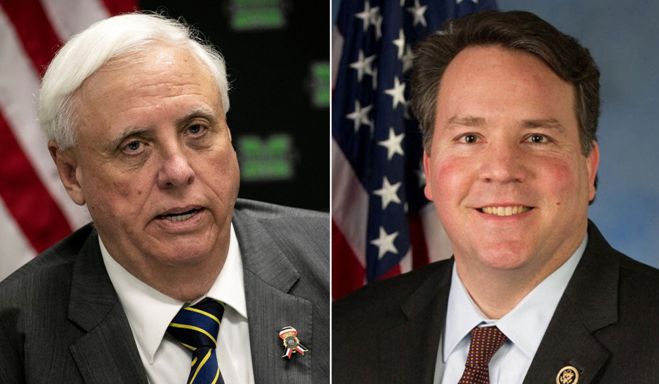 Photo credit: National Review
West Virginia, where energetic conservative Senate candidate Alex Mooney was swamped by doddering moderate Governor Jim Justice in Tuesday's Senate primary as was expected. "Terrifying and loathsome" is pretty much how the GOPe would describe Mooney. We'd describe him as "conservative". The GOPe would agree, and that's their main problem with the 5-term congressman.
Mooney was the first prominent Republican to enter the race against vulnerable Democrat incumbent Joe Manchin, who later tucked his tail between his legs, chose not to run for re-election and went on to briefly pretend that he could become President (or at least stop Donald Trump from being President, which is the most important thing to liberals and fake centrists).
The GOPe, namely Mitch McConnell and Steve Daines (his little toady who runs the NRSC) flew into a panic and dragged Governor Justice into the race by appealing to his ego, thus creating a potentially divisive primary, which is the kind of thing they claim to abhor -- when it suits them.
The latest results show Justice with 61.8% of the vote, while Mooney received 26.5%. Five others collected approximately 12%. With nothing to vote for on the Democrat side, since electable Democrats are all but extinct in the Mountain State (some, like Jim Justice, now label themselves as Republicans), numerous Democrats undoubtedly crossed over and voted in the Republican primary.
Mooney had the support and the endorsements of prominent conservatives like Rand Paul, Mike Lee, Ted Cruz and ex-Senator Jim DeMint; Justice had some semi-conservative endorsements (Marsha Blackburn, Tom Cotton), some moderate-liberal endorsements (Mitch McConnell, Shelley Capito [whose politician-son endorsed Mooney], Lindsey Graham) and some misguided endorsements from alleged conservatives (Donald Trump).
In the end, Justice also had the votes. West Virginia is now a very solidly Republican state; like many others which fit that description, it is in no way a solidly conservative state.
It's fashionable for liberal elitists to refer to West Virginians using words like "hillbilly" and "inbred" because, to them, hatred of White people is always acceptable. Though we reject their racism, it must be conceded that West Virginia politics does sometimes have a certain inbred-type quality to it:
In the CD-1 Republican primary, it was incumbent Carol Miller vs. former J6 political prisoner ("rioter", in biased liberal media parlance) Derrick Evans, age 39, who was briefly a state legislator before being forced to vacate the premises after his politically-motivated conviction in 2021. Miller, who won this primary with 63% of the vote, is a geriatric 73-year-old moderate currently in her third term in the House. She is the daughter of former conservative Ohio congressman Samuel Devine who was in Congress from 1959-1982. Miller's son, a car dealer by trade, was looking to extend the family's political dynasty by becoming Governor. However Chris Miller finished in third place in the 2024 GOP primary with about 20% of the vote and his political career is likely stillborn.
Arch Moore, a moderate Republican like Jim Justice and Carol Miller, many moons ago had a long and legendary political career including 6 terms in the U.S. House and two distinct stints as Governor (he ran 5 times and won 3). Moore was first elected to office in 1952 and last ran in 1988 when he lost his bid for a fourth term as Governor.
His daughter, Shelley Moore Capito, is a moderate-liberal Senate Republican and has been in Congress for nearly a quarter-century since being first elected to the House in 2000 in an upset victory over a megabucks Democrat trial lawyer who outspent her by a 6:1 margin. Justice's imminent elevation to the Senate in November will ensure that this solidly Republican state has two Republicans -- but no conservatives -- in that body for the first time since 1958. The last time West Virginia had two elected (as opposed to appointed) Republicans in the U.S. Senate was 93 years ago.
Capito's son, former state legislator Moore Capito, ran for Governor this year and came in second to state Attorney General and former Senate candidate Patrick Morrisey in the GOP primary. The younger Capito compiled a somewhat conservative record as a member of the state House of Delegates from 2016-2023.
Shelley Capito's nephew, state Treasurer Riley Moore (the true conservative politician in the family), won the 5-way primary to replace Alex Mooney in the U.S. House. After he wins the general election easily in November, it remains to be seen whether his voting record will be as conservative as expected. There's a good chance that he will at least start out that way, as many freshmen GOP legislators do.
Tags:
2024
Indiana
Nebraska
West Virginia
Maryland
|