| 12/3/2025: Tennessee Special Election: Post-Mortem [RightDataUSA] | ||||||||||||||||||||||||||||||||||||||||||||||||||||||||||||||||||

Democrats were counting on Santa coming early to Tennessee this year.

Photo credit: Tennessee Star
Van Epps' win was quite an important result, given the narrow GOP margin in the House, and the amount by which he triumphed is not nearly as important though it will be the subject of rigorous analysis in the media for the next few days before being forgotten.
We have already highlighted much of the Tennessee Democrat's nutzoid viewpoints here, but of course few if any of those things were featured in Aftyn Behn's campaign ads. Instead, those ads focused on the economy, health care, and of course hating on Donald Trump and Republicans. Behn campaigned as a populist rather than as the woke lunatic she really is. She didn't fool quite enough voters, but she did make a dent in the customary Republican MOV in TN-7. DNC chair Ken Martin called Behn's performance "historic", and "a flashing warning sign for Republicans heading into the midterms". Behn hinted that she may run again for Congress in 2026 (please do!), but Democrats are probably not quite so stupid as to allow that. Will anyone admit she was a bad candidate, or at least that she was just an experiment to see how a complete left-wingnut would fare in a low-turnout special election in a supposedly "deep red" district? Will they really stick to this approach going forward? A Democrat who is less radical than Behn would undoubtedly have fared better on Tuesday. In the end, what we have here is yet another "moral victory" for Democrats to go with the actual victory for Republicans. The same thing happened 8 months ago in a couple of special elections in Florida, with Republicans winning and retaining those seats -- but they won by only half as much as they were "supposed" to. Democrats spent an inordinate amount of money trying to purchase an actual "solid red" district (FL-6), but they failed miserably there too. Because Republican Randy Fine won that election by only 14 points instead of 28 points in the R+14 district, Democrats were outwardly cheerful then too despite losing by over 25,000 votes. Today's talking points regarding this tremendous Democrat victory (LOL) on Tuesday:
There is at least one kernel of truth contained within all the spinning, and that is point number two. For example, the recent re-map in North Carolina may help pick up one (1) seat for the GOP in 2026, however at least half a dozen Republican incumbents are endangered in the Tarheel State; the Republicans are still favored in their respective districts but in a "blue" wave a lot of them could drown. Meanwhile in California, the recently-approved Democrat gerrymander not only eliminates 4 or 5 GOP House seats, but also protects half a dozen Democrat incumbents who may have been vulnerable without the new map. When Republicans get into a gerrymandering war with the experts at such things -- Democrats -- they may find themselves outclassed even if the courts actually permit the new GOP maps to be used. 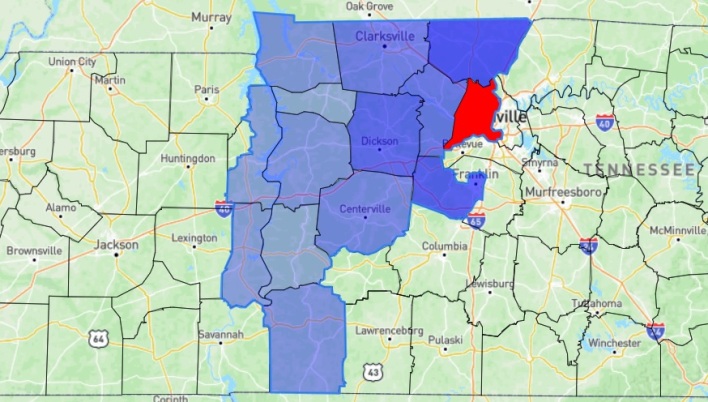
TN-7 results: December, 2025 special election
Election report card:
Montgomery County was disappointing for Van Epps, but the ones other than Nashville saved him. We said, regarding the 2024 House election: "In the other 12 counties combined, Green took over 72%. Van Epps had better get 65% or more, even if he can't quite muster 72%". He got 68.7% in the 12 counties outside of Davidson & MontCo. Generally, the farther away a county is from Nashville, the less it swung to the left on Tuesday (Robertson being an exception; it is adjacent to Nashville but did relatively well for Van Epps anyway). We asked: "Does 54.3% of the 2025 primary vote going to the GOP mean anything for the general election? If so, it probably just sets an upper limit for Van Epps". He took 53.9% as it stands now, very close to that theoretical limit. The relative party vote shares in primary elections in House races rarely forecast general elections with such precision as we saw in TN-7 in both 2024 and 2025. Turnout was certainly a factor, with the early/absentee ballots (which always favor the left) being insufficient to get the Democrat over the hump. We said: "Even with visions of 2018 dancing in Democrat heads, it's possible that turnout next week will not reach that 2022 number (181,000). . . and low pre-election day turnout here -- if it stays low -- may actually favor Republicans". Turnout in 2025 was 180,000 with still a tiny number of votes possibly remaining to be counted. Rats needed a repeat of 2018 as far as motivation was concerned; instead they got a repeat of 2022. That wasn't bad at all for a special election, but not nearly enough to tip the scales. We also predicted a Van Epps win "by 2 or 3 points". His MOV was 8.9% and that, under the circumstances, is a significant accomplishment even if it's not anywhere close to the 16% GOP lean of the district. Democrat money, motivation and organization had a big impact (as they always do in low-turnout special elections), but those things didn't make a big enough impact because Republican voter turnout on Election Day dwarfed that of the Democrats'. As we have noted above, the outcome in TN-7 was quite similar to the special election in FL-6 in April -- with the GOP winning, but only by half the normal amount. As in FL-6, although they invested heavily in the special election and claimed a moral victory, Democrats will not be spending quite so outrageously in 2026 in solid "red" districts, so Van Epps should be safe in TN-7 (except perhaps in a primary) from this point through at least 2030. One final word about this district: of the 435 House districts nationwide there are 212 which lean R; 5 are rated even; and 218 lean D, not factoring in any of the 2025 redistrictings yet. TN-7 is rated as R+8, which ranks it only as the 139th most Republican district in the country (tied with 12 others). Even if you accept Charlie Cook's rating of R+10 instead of our R+8, that would rank TN-7 121st at best. In either case, that's a curious definition of "dark red". It's just ordinary red, that's all. But the media and other Democrats are obliged to make it sound to their unenlightened followers as if the greatest upset in election history almost occurred here. Tags:
2025
Tennessee
Special election
Merry Christmas!
| ||||||||||||||||||||||||||||||||||||||||||||||||||||||||||||||||||