| 11/20/2025: Senate Prospects For 2026: Part Two, Voting Schemes and Pipe Dreams [RightDataUSA] |
We've already covered the eight U.S. Senate seats which have the greatest probability of changing hands in 2026. The list includes 3 seats currently held by Democrats and 5 which have GOP incumbents. Most of the other 27 Senate seats which will have elections next year appear to be perfectly safe for the party which holds them. A few others fall just short of "perfectly safe".
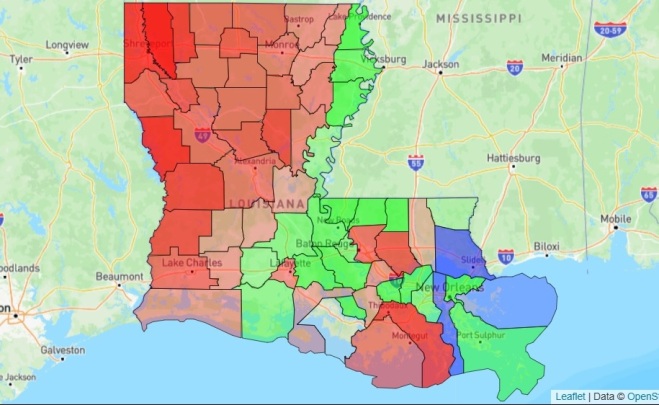
Louisiana gubernatorial jungle primary, 1987
Louisiana:
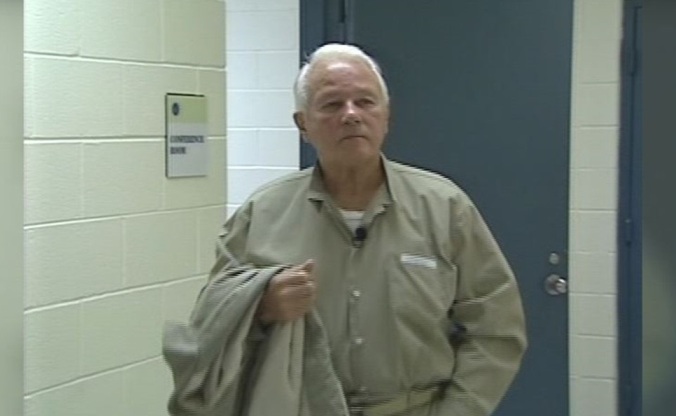
Photo of inmate No. 03128-095 from wwltv.com
What really triggered Edwards was the February, 1972 gubernatorial race, in which he first won the Democrat primary against over a dozen other candidates (but did not even get 25% of the vote) and then narrowly prevailed in a grueling runoff against Bennett Johnston and then had to face Republican David Treen in the general which turned out much closer than expected. Treen had cruised easily through the GOP primary and did not need to endure any runoff. So why, Edwards asked, should the vastly outnumbered Republican party be guaranteed a spot on a general election ballot like in every other state, while Democrats had to face as many as two bruising contests just to get to that same spot?
As of 2004 the tide had turned, and Democrats (and liberal Republicans) knew it. Then came the mass exodus of New Orleans Democrats as the result of Hurricane Katrina in 2005; New Orleans was already in population decline but the hurricane momentarily accelerated the process. From that point forward it has been Democrats who almost always find themselves on the outside in a general election, not simply because New Orleans temporarily lost about 100,000 potential voters, but because the general preference of Louisiana voters has done a 180-degree turn away from Democrats and towards Republicans. Since 2007 only Dirty Mary Landrieu in 2008 and John Bel Edwards (fluke wins in 2015 and 2019) have been able to prevail statewide as Democrats in Louisiana. Liberal Republicans like Bill Cassidy have (along with Democrats) lately decried the jungle primary, and in 2024 the state legislature passed a bill which reverts to closed, single-party primaries for elections for federal offices effective as of 2026; elections for state and local office in Louisiana will continue with the jungle primary. The new scheme is a "win" for liberals of both parties: Democrats get a guaranteed spot on a general election ballot; RINOs no longer need to deal with Democrats taking votes from them in a primary, and thus stand a better chance against real Republicans. In a supposedly "closed" GOP primary, Cassidy will receive a higher percentage of votes than he would in a jungle. He will be the winner if several conservative candidates split the right-wing vote while Cassidy has all of the left-wing votes for himself. Most likely, however, Cassidy will still need to survive a primary runoff. That won't be as difficult as it may sound. One very important provision of the new law which eliminated the jungle primary is that independent voters -- and there are plenty of those in Louisiana (nearly 30%) -- can cast a ballot in whichever primary they choose. Take a bunch of "moderate" independents, add in some Democrat voters who switch and become Republicans temporarily, and RINOs are suddenly far less endangered than they were before. If Cassidy's fate was decided only by true Republicans, it wouldn't be pleasant for him. Cassidy's #1 opponent at the moment is state Treasurer John Fleming, a 74-year-old Republican. Democrats have nobody worth mentioning. Fleming served 4 terms in the U.S. House from the 4th District from 2009-2016; the guy who replaced Fleming in that district in 2016 is now the Speaker of the House. Fleming is a very solid conservative, and if other conservatives stay out of the May, 2026 Senate primary, Fleming has an excellent chance to win. November would be a formality. But the primary will not be so simple, and that works to the advantage of RINO incumbent Cassidy because the non-RINO primary vote will be fractured. Other prominent candidates include first-term state Senator Blake Miguez, who is a moderate-conservative; and St. Tammany Parish councilwoman Kathy Seiden, who is a young, attractive Christian conservative. 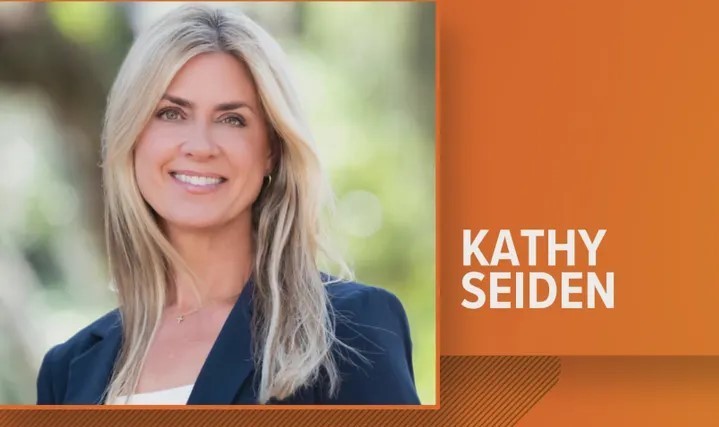
Photo credit: wwltv.com
Cassidy has a major cash advantage, Miguez and Fleming are building their war chests, and Seiden has only recently thrown her hat into the ring. Whoever wins the GOP primary will be Louisiana's next U.S. Senator. Miguez, though more of a centrist, will still take more votes from Fleming and Seiden than he will from Cassidy. Best case scenario is that at least one of the two actual conservatives makes the runoff. With one Democrat now guaranteed to be on the general election ballot (thanks again, Louisiana RINOs) billionaire ActBlue contributors may go all-out to try to steal this seat, but this is one state where it is very unlikely that they will succeed.
Alaska: 
Democrats have nobody yet for this race in what people falsely assume is a Republican state; the GOP has only 24% of voter registrations in Alaska while 59% are registered independents. But the Democrats believe (and left-wing polls back them up) that fake-moderate ex-congresswoman Mary Peltola would be a formidable opponent against incumbent Republican Dan Sullivan. Sullivan, an actual moderate, was first elected to the Senate in 2014 when he defeated incumbent Democrat Mark Begich and then was re-elected in 2020 by an unimpressive margin over big-spending liberal Al Gross.
Kentucky: 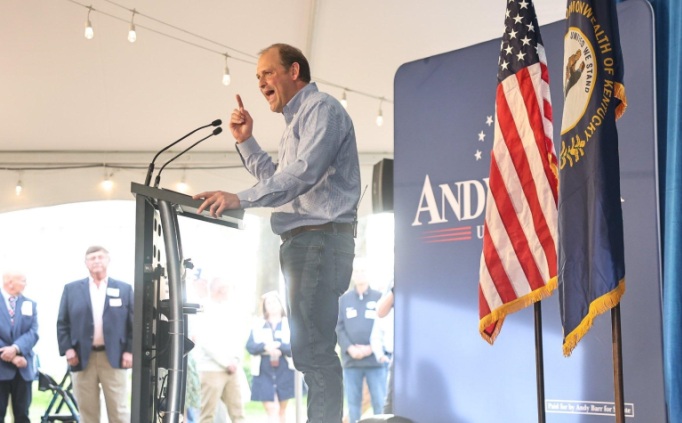
Photo credit: Lexington Herald Leader
The Bluegrass State is wide open due to the long-overdue retirement of Mitch McConnell. The best-known candidates in the Republican primary are moderate congressman Andy Barr and former Attorney General Daniel Cameron. Barr has represented the Lexington-area district in Congress since 2013 and he's turned what was once a marginal House seat into a rather safe one which Democrats no longer seriously go for in most elections; they are putting it back on their radar in 2026, however. Cameron, elected as A.G. in 2019, was seen by some on the right as insufficiently tough on Democrat crimes while in office, and his bid to move up to Governor ended dismally when he was totally outclassed (and vastly outspent) in 2023. There is also businessman Nate Morris running on the GOP side, and he is definitely the most conservative option of the three. Barr is currently the leader in the fundraising portion of the race.
A recent addition on the Democrat side, presumably for additional comic relief, is horse trainer Dale Romans. Horses are big in Kentucky, and this guy's full of as much horseshit as any of them. He also wants to be the W.C.H. candidate in the contest, and describes himself as an "independent" Democrat even as he spouts the same nonsense as all other (presumably non-independent) Democrats. Bernie Sanders is an "independent" too. McGrath is the most likely of the above to be the Democrat nominee, but nobody currently has any illusions that she will win. Morris may have a better shot than anticipated on the GOP side, but a squish like Barr probably has the best chance of winning a general election, and therefore the big money and big endorsements will be behind him. Cameron is currently being slimed with unproven allegations of misconduct while Attorney General, and he is also a proven statewide loser. Cameron appears to be the favorite to finish third in the GOP primary. Minnesota: 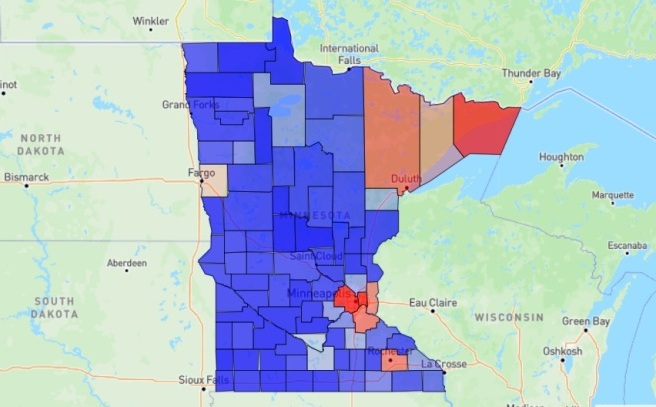
2024 presidential results in Minnesota
This state, like Virginia (see below) is nothing but a Republican pipe dream. The congressional delegation is always pretty well balanced, either 4-4 or 5-3 every election since 2000. The state House and state Senate are very close. Minnesota doesn't register voters by party, but a company whose business it is to estimate party breakdowns calculates that Minnesota is one-third Democrat, one-third Republican and one-third independent or minor parties. This may be an oversimplification, but the Twin Cities and their suburbs (at least the first two "rings") are terrible, the rest of the state is fine. The first part of that sentence is definitely true, anyway.
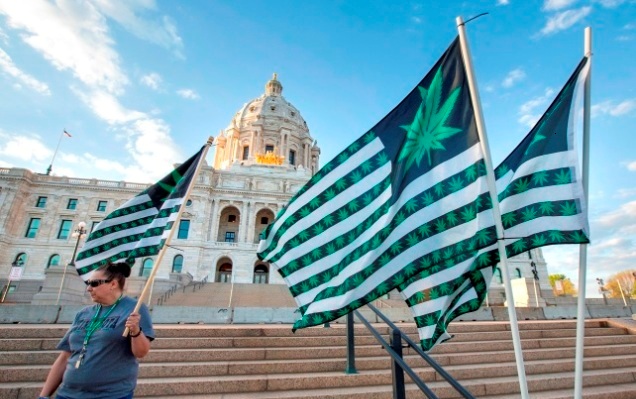
Photo credit: house.mn.gov
Speaking of "pipe dreams". . . one explanation for some of the previously close outcomes is -- or was -- the presence of doper parties on the ballot. The "Grassroots-Legalize Cannabis" party and the "Legal Marijuana Now!" party are both recognized political entities in Minnesota, but they ceased fielding candidates after 2022. That's because they no longer have any reason to do so; in 2023 the Democrat legislature passed a very lenient law which legalizes cannabis for any type of use, not just medicinal. The fact that the doper parties are now obsolete helps Democrats, because these parties were regularly siphoning off thousands of left-wing votes in major elections.
Republicans are pretending that they have a chance to pick up the Minnesota Senate seat in 2026. It is an open seat, being vacated by Democrat Tina Smith, who is retiring. Smith, who compiled a nearly 100% liberal rating while in the Senate, was first appointed in 2018 when Democrats forced another liberal Democrat, sexual predator Al Franken, to resign. Smith's most recent election in 2020 was a good example of how Democrats were once hindered electorally, as two stoner candidates combined to take 7.7% of the vote away from her. So Smith only won by about 5 points instead of 12 or 13 points. The 2026 Democrat primary will be between Lt. Governor Peggy Flanagan and congresswoman Angie Craig. Flanagan has some problems, such as financial improprieties in her office, and being endorsed by Bernie Sanders; Craig is one of those lifelong liberals who suddenly sprints hysterically towards the center when seeking higher office. There's a 98% chance (rounding down) that one of these two will be the next ultra-liberal U.S. Senator from the state of Minnesota. Ex-professional basketball player Royce White ran for the Senate in 2024 in Minnesota against Amy Klobuchar, and the Republican was stomped by over 15 points, a good example of a margin of Democrat victory when the dopers no longer split the left-wing vote. He is running again in 2026. White moved quickly across the political spectrum, going from left-wing hero in 2020 when he was leading Black Lives Matter protests after the death of "St. Floyd of Fentanyl" (White does have a history of mental illness); he's recovered from that, and is now described as a "right-wing populist". White has just as much chance of winning in 2026 -- none at all -- as he had in 2024. And he is the probable front-runner among Republicans, which shows just how much of a barren wasteland Minnesota is for the GOP. None of the state's 4 moderate Republican congressmen want any part of this race either. 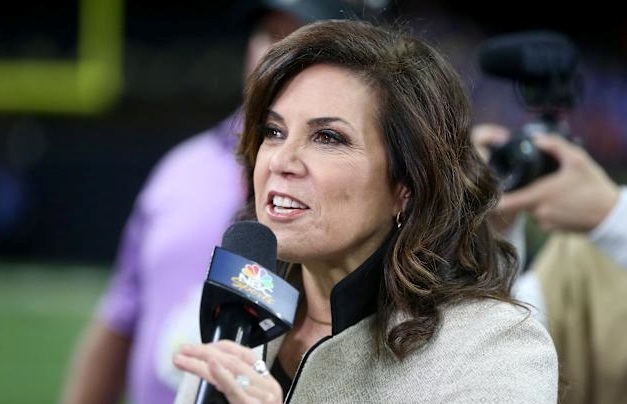
Photo credit: yahoo.com
This foregone conclusion of an election might be spiced up a bit if ex-sports broadcaster Michele Tafoya were to enter the race on the GOP side. Tafoya was a long-time sideline reporter for NFL games, and during her career she was employed by several networks including CBS, ESPN and NBC. She retired from that profession in January, 2022; the last game she worked was Super Bowl LVI.
Nebraska: 
Photo credit: Zach Wendling/Nebraska Examiner
Democrat-in-disguise Dan Osborn is the Great "Independent" Hope for the left in the state of Nebraska. Fresh off of a defeat in the 2024 Senate election against incumbent GOP squish Deb Fischer in which he came closer than some expected, Osborn is rested and ready to give it another go in 2026. Osborn took all of the Democrat money he could get in 2024, but concealed his true political identity by refusing to accept the Democrat party label which is repugnant in the Cornhusker State outside of Omaha and Lincoln. Not even including all of the supposedly-independent liberal cashflow coming from outside the state, Osborn's fundraising dwarfed that of Fischer. Numerous polls showed a close race in 2024, and some even had Osborn prevailing by a small amount. Osborn won the two big liberal cities and lost everywhere else; the final outcome was a 6.7% victory for the Republican. Only one or two forecasters actually got it right; the other polls (nearly all of which were paid for by Osborn's campaign) were nothing but wishful thinking, propaganda and hot air.
Virginia: One last word about a ridiculous GOP pipe dream state: there are probably some folks out there who are still in disbelief regarding the 2025 election results in Virginia. Unwilling to accept the reality that the Old Dominion is not remotely competitive anymore, they may think that outgoing Republican Governor Glenn Youngkin could somehow repeat his fluke win from 2021 in the 2026 Senate race against well-entrenched liberal Mark Warner. Youngkin is a good man, and he stood up just recently against Virginia Democrats' attempt (which will succeed) to gerrymander the state's congressional districts and disenfranchise Republicans, costing them 2 or perhaps 3 seats. Youngkin is not a stupid man, and to all indications will not be entering a Senate race that he is extremely unlikely to win. If Youngkin declines, Republican pickup chances of the Virginia Senate seat drop from maybe 20% to absolute zero. Drop the pipe, wake up from the dream, and look elsewhere for potential Republican pickups. Tags:
2026
Senate
Louisiana
Alaska
Kentucky
Minnesota
Nebraska
Virginia
|
| 11/17/2025: Senate Prospects For 2026: Part One, The Flippables [RightDataUSA] |
We have already examined the outlook for 2026 in the aftermath of the 2025 elections. Most of that commentary focused on the U.S. House and how the results from the last disastrous midterm election (2018) might foreshadow the upcoming potentially disastrous midterm election. We spent little time on the Senate, but noted that although 2018 was a train wreck for Republicans over almost the entire ballot, there was one minor exception: Republicans actually gained 2 Senate seats in 2018 and with some luck it could have been as many as 6. Because it was only a net +2, most observers on the right were extremely disappointed. Yet holding onto the Senate at all in 2018 was an important accomplishment and an impressive one under the circumstances. It kept rabid Democrats at least partially at bay. Recall what Democrats did with their total control of the House, and imagine what would have occurred with them in charge of the Senate during the final two years of Trump's first term in the White House.
It is not the same in the Senate, where an entirely different set of Senate seats from 2018 will be contested in 2026, and that makes specific comparisons to 2018 impossible. Members of the "Class of 2018" completed their six-year terms in 2024; it is the "Class of 2020" which is up next year. Only one incumbent Senator who was elected in 2018 -- Mississippi Republican Cindy Hyde-Smith -- will be on the ballot again in 2026. That's because her 2018 win took place in a special election for a 2-year term. Unlike 2018, 2020 was not a good year at the Senate level for the GOP. They suffered a net loss of 3 seats, turning their 53-47 majority into a 50-50 tie which was broken by the newly-elected Democrat Vice President. The Republican majority was still intact (52-48) in November; GOP control wasn't actually forfeited until January of 2021 when Democrats won two runoff elections in Georgia. Republican incumbents had lost in two other states (Arizona, Colorado) in November but the GOP picked up Alabama. Democrats tried to purchase a much better Senate result than merely +3 in 2020, spending ungodly amounts of money in losing efforts in states such as Alaska, Iowa, Kansas, Kentucky, Maine, Mississippi, Montana, North Carolina and South Carolina (outspending the victorious GOP candidate in every one of them). That was in addition to the ungodly amounts of money the Democrats spent in their winning efforts. According to OpenSecrets.org, Democrats in the 2020 general election spent over $1.1 BILLION dollars to acquire control of the Senate, an amount of money 60% higher than Republicans could come up with. Campaign finance will be a recurring theme in the 2026 previews below, with Democrats just about 100% guaranteed to obtain more money than their Republican counterparts in every state where there is even the slightest chance that Democrats can compete -- -- unless the Democrats and their "ActBlue" money laundry are finally forced to obey the same campaign finance rules that Republicans have to live by. 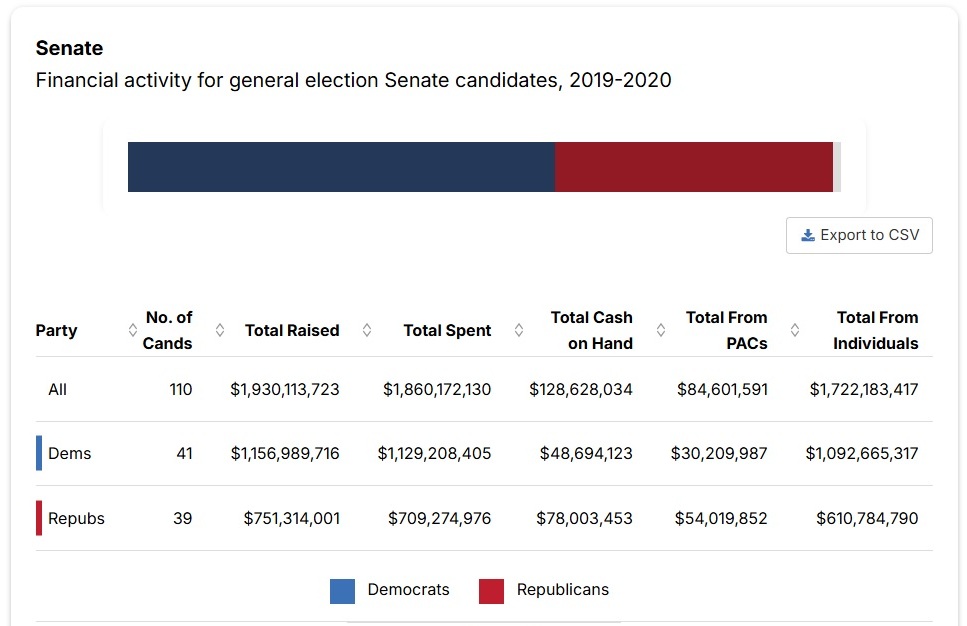
Source: OpenSecrets.org
The current Senate terrain is not as favorable as it was in 2018, when Democrats had to play defense in most of the contested states. In 2026 Republicans have 22 seats to defend (including special elections in Florida and Ohio) while Democrats are up in only 13 states. Of those 13, just 3 present any real opportunity for a GOP gain while there are a minimum of 5 juicy targets for Democrats this time around. All things considered, the playing field is clearly tilted towards the left here.
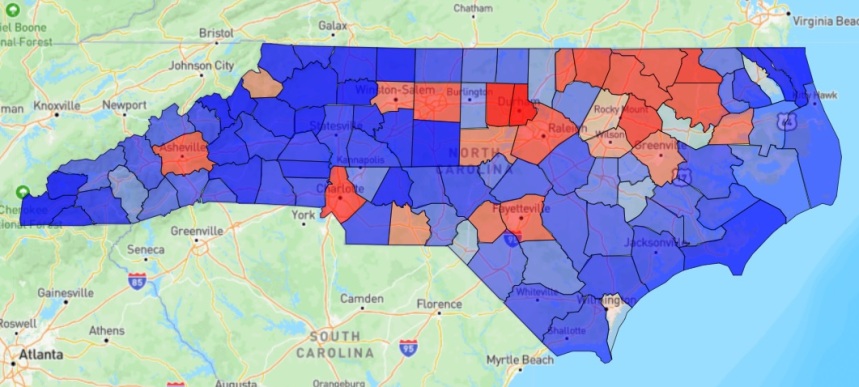
North Carolina Senate results from 2020
1. North Carolina:
Liberal former congressman Wiley Nickel was the first to jump in on the Democrat side, but he was merely a placeholder until phony moderate ex-Governor Roy Cooper made his decision to go for the Senate. To nobody's surprise, Cooper declared his candidacy in late July and within hours received millions of dollars in possibly-legal campaign donations. The latest financial reports from the FEC show Cooper with nearly 8x the amount of cash as Whatley. Cooper will probably eventually raise and spend at least $100 million here; Whatley will never get close in that department. Though out of office for nearly a year now, Cooper is still very popular in the Tarheel State -- at least with the liberal media, who never tire of reporting how popular Cooper is. For all his alleged popularity, Cooper's electoral record isn't very impressive in this closely-divided "purple" state. He was sufficiently well-liked to win 4 terms as state Attorney General, but his percentages as Governor were 49.0% in 2016 and 51.5% when being re-elected in 2020. Cooper's first gubernatorial win was aided by hysteria over the so-called "Bathroom Bill" which was passed by the Republican-controlled North Carolina legislature and signed by Republican Governor Pat McCrory in 2016. A bathroom bill is legislation that protects the safety and privacy of girls and women in public bathrooms against intrusion by boys or men who claim (or pretend) to be transgendered. You can understand why Democrats would be indignant about something like that. The liberal media concocted some figures purporting to show that the bill would cost North Carolina a hillion jillion dollars in lost revenue because woke companies (like PayPal and Adidas) and woke organizations (like the NCAA) would pull out of the state. The 2016 gubernatorial election turned on this single issue, with Cooper supporting the efforts of Organized Deviancy and McCrory supporting common sense. Common sense was defeated that November, 49.0% to 48.8% with a Libertarian spoiler taking enough votes from McCrory to hand the win to the Democrat without a majority. The Republican legislature caved early in 2017 and repealed the bill. Cooper's far-left stance on most issues is well-known to North Carolina voters despite the best efforts of the media. Republican Lt. Governor Dan Forest challenged Cooper in 2020, but lost by 4.5%. Forest was banking on voter disapproval of Cooper's authoritarian tactics during the COVID plandemic, but the voters weren't disapproving enough. Natural (or even laboratory-made) disasters seem to work in favor of Democrats in North Carolina despite that party's inept or ham-fisted approach to the problems; for example, the inept and even criminally negligent response to Hurricane Helene in 2024 -- Joe Biden's FEMA refusing to help people who had "Trump" signs in their yards (they did the same thing in Florida too), and local Democrats' relief efforts discriminating against Whites -- was supposed to be a boon for the GOP in that year's elections; Trump did win the state, but the most-affected areas in Western North Carolina actually moved to the left. Trump's win was a close one, and other Republicans on the ballot received no boost at all from the Democrats' mishandling of the hurricane aftermath. Speaking of disasters, Whatley is likely to help fulfill the media's mission of making Cooper look more popular than ever. The Republican nominee will be grossly underfunded and largely uninspiring to the voters. Early polls are exactly as one might expect: Cooper with a lead but running under 50% for now. At least 10-15% of the electorate is still undecided, which is also what one might expect. This race is, and always has been, Cooper's to lose. Another potential dire consequence is this: if Whatley loses convincingly next November, there are several Republican House incumbents in North Carolina who could go down with him because most GOP districts in the state are either in the tossup range or very close to it. 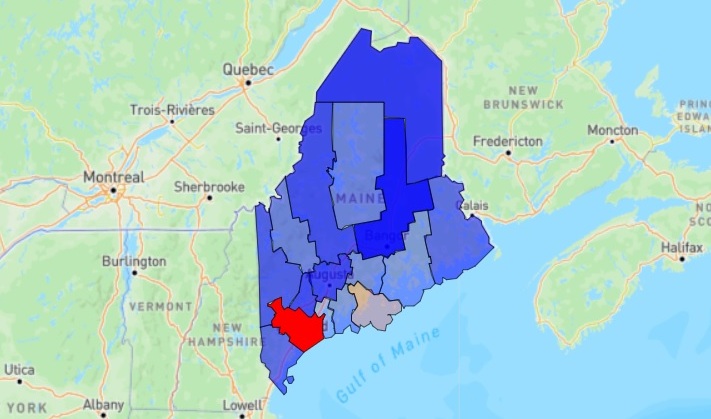
Maine Senate results from 2020
2. Maine:
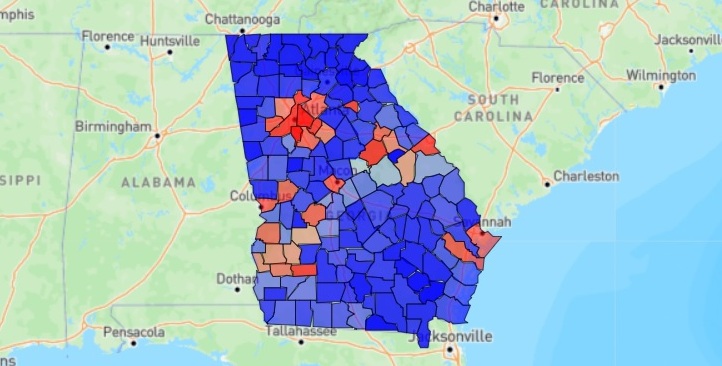
Georgia Senate results from 2020 runoff
3. Georgia:
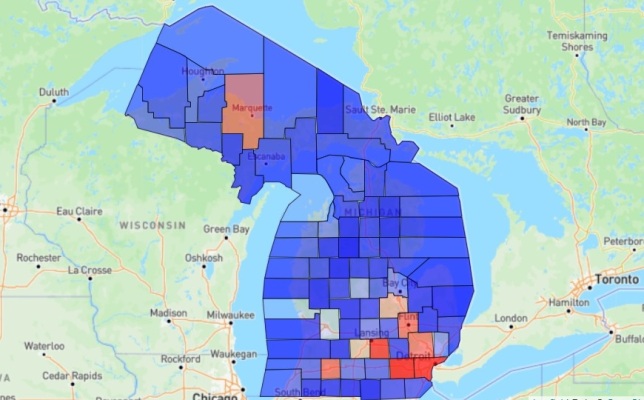
Michigan Senate results from 2020
4. Michigan:
5. New Hampshire: Seventy-eight-year-old Democrat Senator Jeanne Shaheen is ending her political career in 2026 after 6 years as New Hampshire Governor followed by 18 years in the Senate. After her 3 terms in Concord her string of election wins was interrupted in 2002 when she ran against incumbent Senator Bob Smith. Only it turned out that Smith wasn't her #1 opponent that year after all -- Smith lost in the primary to congressman John E. Sununu who, despite being outspent by both Shaheen and Smith, won just over 50% of the vote in the 2002 Senate election. He was the youngest member of the Senate during his term. Shaheen won the rematch 6 years later and held the Senate seat for two more terms after that. Sununu had been out of politics since his 2008 defeat, but he's back for another go at it. Do not confuse this Sununu with his younger brother Chris, who is the former Governor of New Hampshire (2017-2024). Also do not confuse him with his father John H. Sununu, who was George H.W. Bush's Chief of Staff. That Sununu is the one who gave us John Souter as a Supreme Court justice and who convinced his employer that "read my lips, no new taxes" was somehow not a good idea and shouldn't be taken literally. Sununu's employer's reward for following that advice was a trip to the unemployment line after 1992. 
Photo credit: John H. Sununu
Chris and his father are RINOs, if not outright Democrats; John E. Sununu is the conservative in the family. By "Sununu" standards, anyway. He's one of those oxymoronic "fiscal conservatives" now (i.e. anti-conservative on every other issue). There's no such thing as a fiscal conservative/social liberal. Because "social liberalism" is clearly anything but fiscally conservative when you look at how much those social programs cost.
Just as Sununu had to face an experienced senator (Bob Smith) in the GOP primary during his first run for that office in 2002, he will be facing another one in 2026 -- ex-Massachusetts Senator Scott Brown, who was a fluke winner in 2010 to replace the deceased Teddy Kennedy. Brown won 52% of the vote against Democrat Attorney General Martha Coakley. How repugnant do you have to be to lose to a Republican in Massachusetts? Coakley's done that twice. Brown started off as a moderate in the Senate, but even running hard to the left was not enough to save him in 2012. Brown did run well ahead of Mitt Romney in Massachusetts that year, and in both of his Senate races he showed an ability to run neck-and-neck against Democrats in terms of campaign cash. Brown relocated to the north by 2014 and ran again for Senate in his new home state of New Hampshire. In that year's crowded GOP primary, one of the defeated candidates was good old (age 73) Bob Smith again. Brown came reasonably close to defeating Shaheen, but this time he was conclusively outspent and that was a major factor, as of course were the "carpetbagger" allegations though Brown was actually born in New Hampshire. Bob Smith, by the way, is still around and has endorsed Brown for 2026. Instead of attacking each other too much (yet), both Sununu and Brown are training their artillery mainly on presumptive Democrat nominee Chris Pappas, who is currently the congressman from New Hampshire's 1st District. Pappas is in his fourth term and, like so many other liberal Democrats who seek higher office in states which are not solid "blue", has suddenly pretended to discover moderation after being nearly a 100% party-line liberal vote prior to 2025. Sununu, who only jumped into the race recently, is the current favorite for the GOP nomination and matches up better against Pappas in general election polling. New Hampshire is about as closely divided a state as there is, but Democrats always seem to eke out victories and 2026 isn't likely to be any different. This race is definitely a toss-up, but there's a strong likelihood that the Republican will be the one getting tossed (out), albeit not by a very large amount. 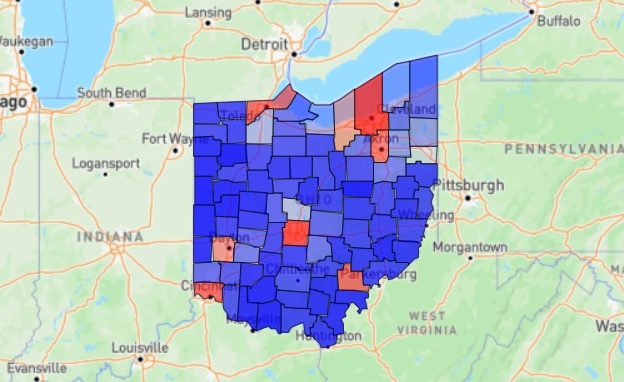
Ohio Senate results from 2024
6. Ohio:
Brown's luck -- but not his money -- finally ran out in 2024. Brown and the Democrat Money Machine spent over $100 million to repurchase his Senate seat, but Republican Bernie Moreno was able to ride Trump's coattails to a 3.6% win after trailing in all polls until October. Moreno, though outspent 4:1 and overwhelmed by Brown's advertising presence in all types of media, won every Ohio county except the urban ones, one suburban county (Lorain) near Cleveland, and the academic wasteland of Athens County (University of Ohio). Moreno prevailed by over 200,000 votes in all. With Ohio Democrats having nowhere else to turn in 2026 -- ex-congressman Tim Ryan declined and so did a couple of ghetto congresswomen -- Brown was tabbed to try to regain the Senate seat he occupied as recently as a few months ago. Ryan had run for the Senate in 2022 against Vance and suffered a humiliating loss despite having the usual astronomical cash and media advantages which accrue to Democrats even in GOP states. It's not quite accurate to say that Ohio Democrats had nobody else willing and (financially) able to oppose Jon Husted. A Cleveland-area millionaire Democrat named Fred Ode jumped into the Democrat primary back in August and prepared to invest $5 million of his own money to show he was serious. Ode entered the Democrat primary because he feels that "old-school" Democrats like Sherrod Brown are not filled with sufficient hatred of Donald Trump and all other Republicans. For that reason, Ode believed that someone like Brown was unlikely to win against Husted next year. Ode definitely has a point about hatred being the ultimate motivator for Democrat voters (or have we already forgotten the election results from earlier this month?). However just a few days ago Ode suddenly and mysteriously aborted his campaign which was still in its first trimester. Clearly angry (apparently as usual for him), Ode still did not give a reason. Perhaps Ode made his decision after finding a decapitated horse's head in his bed one morning? The Democrat establishment is every bit as capable of hatred and violence as the insurgents from the far left. Radicalism may work well for Democrats in New York City and California and (soon) Maine or even Texas -- and don't forget Virginia now -- but not necessarily in middle-America, apple-pie Ohio. Democrat leaders feel that their chances in Ohio are much better with Brown than with Ode or someone like him. For 2026, early polls showed Husted moderately ahead of Brown but recent Democrat-leaning polls have it pretty much a tie. Ohio, along with Maine and North Carolina, could flip from R to D next year and result in a 50-50 tie for the Republicans in the Senate if those losses are not offset elsewhere. Any additional Republican losses in the Senate would hand control to Democrats. With the Senate almost within their grasp, Democrat billionaires will be tossing around campaign cash like never before, and things like a Republican being outspent only by a margin of 4:1 will seem quaint. 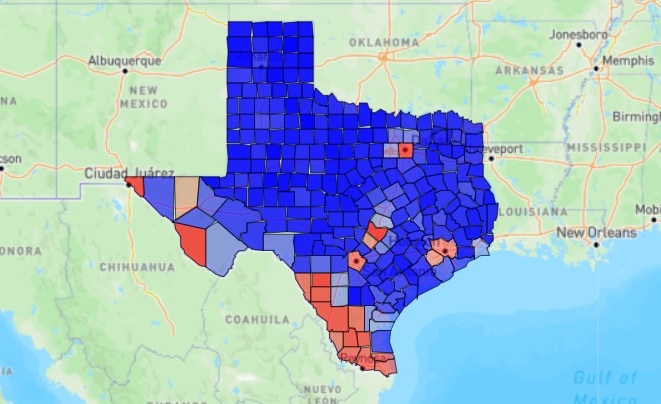
Texas Senate results from 2020
7. Texas:
On the GOP side in Texas in 2026, we'll have incumbent senator John Cornyn vs. state Attorney General Ken Paxton vs. congressman Wesley Hunt. On the left, we'll have ex-congressman Collin Allred (back for a second try at higher office) vs. state House member Holy James Talarico. A late addition to the tag team could be congresswoman Jasmine Crockett, the self-appointed moral voice of the shrieking, hysterical (but dominant) wing of the Democrat party, and darling of the radical-left media. She believes herself to be the Texas version of AOC, and presumably considers that designation a complement. Crockett already has raised at least $6.5 million (which is more than Talarico or Allred have done), and that's far more money than necessary for her to run in some little House district which is rated at least D+10 and will have no viable GOP alternative. It certainly looks like she's running for the Senate, but we'll have to wait to find out for sure. Queen Latifah Crockett has declared that she will make her solemn pronouncement at the filing deadline, which is December 8. What reason would there be for her to not run for Senate? Aside from avoiding the risk of losing in the Senate primary, Crockett may realize that another easy House win in her district -- combined with the reasonable likelihood of Democrats taking control of the House after 2026 -- would give her a position of greater power and perhaps a juicy committee chairmanship. Worst-case scenario for Crockett is that she loses the Senate primary, is out of Congress starting in 2027, but then is hired by "The View", which obviously can never have enough shrill, unattractive women on its panel. 
Photo credit: splinter.com
Talarico describes himself as a deeply religious Christian, but is a phony who spouts that "Jesus-was-a-liberal" bullshit a la the self-righteous "He Gets Us" television ad campaign, which you may have seen. Picture Talarico as a combination of Bernie Sanders and Jimmy Swaggart (apologies to Swaggart). Talarico the "True Christian" adamantly opposed displaying the Ten Commandments in Texas schools, preferring that those institutions remain atheistic and free from anything which might accidentally encourage good moral values. He represents an ultra-liberal (D+26) Austin district in the state House, so Talarico's views are surely considered to be mainstream by his constituents but most of the rest of the state of Texas would disagree. Talarico is a one-trick pony, wearing his version of far-left Christianity on his sleeve at all times and using it to explain all of his immoral, pro-abortion, pro-crime and other radical votes in the legislature. He surely believes he can "out-liberal" and "out-hate" Crockett and Allred, but he's got his work cut out for him in those departments.
Senator Cornyn is a squish but he is always a well-funded one. The 73-year-old has been in the Senate since 2003. He compiled a conservative voting record during his first two terms, but now has become so unreliable (i.e. "moderate") that he was actually eligible to apply for the job of Senate Majority Leader after Mitch McConnell stepped aside. No true conservatives need apply for that position, which was won by John Thune in a November, 2024 secret ballot of GOP senators. The outcome was said to be close. Cornyn has been in a panic throughout 2025, awkwardly trying to appear conservative (at least through next March's primary), furiously raising money and becoming more popular with the media as he and his allies toss allegations at his closest challenger, Ken Paxton. 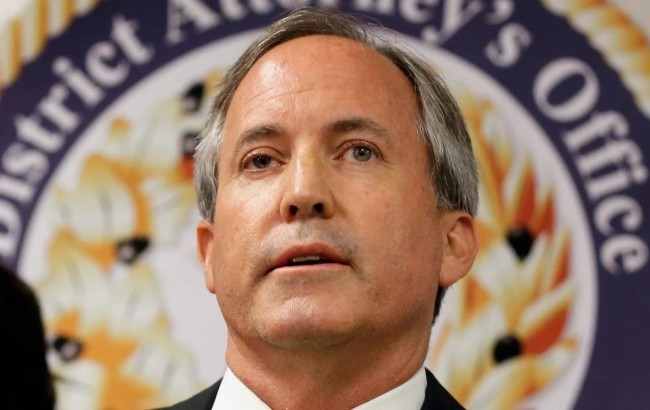
This is nothing new for Ken Paxton. The former state legislator was first elected as Texas Attorney General in 2014, succeeding Greg Abbott in that office as Abbott stepped up to become Governor. The solidly-conservative Paxton quickly showed that he was (and still is) one of the most effective A.G.'s in the entire country. However he is much too effective to suit the RINOs who perpetually have control of the Texas GOP and the Texas state House; Democrats loathe him even more than RINOs do.
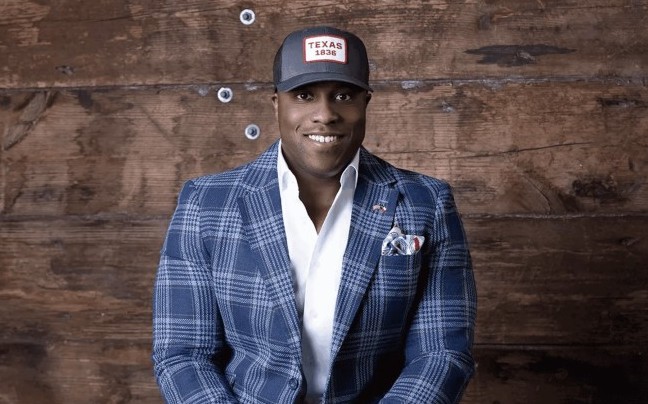
Photo credit: Texas Scorecard
As noted above, the GOP primary is not just a 2-way race anymore. In October, congressman Wesley Hunt announced that he would abandon his safe (R+10) district in the suburban Houston area and join the Senate race. The 44-year-old Hunt has a fine military background, graduating from West Point in 2004, serving 8 years in the U.S. Army before earning 3 Masters' Degrees, and then entering politics. Hunt's first bid for Congress came in 2020 in the deteriorating 7th District and was unsuccessful though he made a solid showing (47.5%) under difficult circumstances. When the new 38th District was created in 2022 in approximately the same area, Hunt won a majority in a crowded 10-way Republican primary and then easily sealed the deal in November. Hunt was re-elected in 2024 with only token opposition, and has been a reliable conservative vote in the House. He currently trails his primary opponents in fundraising (and is way behind the wealthy Democrats) but he's only been in the race for about 6 weeks.
Iowa Senate results from 2020
8. Iowa:
Tags:
2026
Senate
North Carolina
Maine
Georgia
Michigan
New Hampshire
Ohio
Texas
Iowa
|